中国畜禽种业 ›› 2026, Vol. 22 ›› Issue (10): 44-54.doi: 10.19543/j.cnki.1673-4556.20260921.003cstr: 32418.14.j.cnki.1673-4556.20260921.003

• 遗传改良 • 上一篇    下一篇

我国肉牛杂种优势利用研究进展与展望

张晓燕1(), 李姝涵1, 樊毅杰1, 安腾原1, 王娜2, 张山3, 任刚1,4()   

  1. 1. 西北农林科技大学动物科技学院,陕西 杨凌 712100
    2. 天津力牧生物科技有限公司,天津 300480
    3. 牛智谷控股(阳信)有限公司,山东 滨州 251802
    4. 农业农村部动物生物技术重点实验室,陕西 杨凌 712100
  • 收稿日期:2026-06-15 出版日期:2026-10-26 发布日期:2026-09-29
  • 通讯作者: 任刚
  • 作者简介:
    张晓燕(1990—),女,博士,山西人,研究方向:动物遗传育种与繁殖,Email:。
  • 基金资助:
    陕西省杰出青年科学基金项目(2025-JC-JCQN-057); 国家自然科学基金项目(32472880)

Advances and future perspectives on heterosis utilization in Chinese beef cattle

Xiaoyan Zhang1(), Shuhan Li1, Yijie Fan1, Tengyuan An1, Na Wang2, Shan Zhang3, Gang Ren1,4()   

  1. 1. College of Animal Science and Technology, Northwest A&F University, Yangling, 712100, China
    2. Tianjin Boyaleap Biotechnology Co. , Ltd. , Tianjin, 300480, China
    3. Niu Zhigu Holdings (Yangxin) Co. , Ltd. , Binzhou, 251802, China
    4. Key Laboratory of Animal Biotechnology, Ministry of Agriculture and Rural Affairs, Yangling, 712100, China
  • Received:2026-06-15 Online:2026-10-26 Published:2026-09-29
  • Contact: Gang Ren

摘要:

高效开发利用肉牛杂种优势,是突破肉牛生产性能瓶颈、驱动我国肉牛产业高质量转型升级的关键育种技术,在现代肉牛种业发展中具有重要应用价值。然而,杂种优势的遗传基础复杂,形成机制解析不透彻,在实际育种应用中仍存在明显短板。本文围绕“机制解析-预测方法-育种应用”,系统阐述了杂种优势的概念与该技术在肉牛育种中的应用价值,从经典遗传学与表观遗传学两个层面梳理了其形成的分子机制。在杂种优势预测方法相关论述中,整理了配合力测定、遗传距离分析两类典型的传统方法,并梳理了现阶段这类方法存在的应用难点与优化方向。本文回顾了我国肉牛育种的发展历程,在从传统役用功能转向专门化肉用方向转型的过程中,国内育种体系已初步建成,生产性能得到一定提升。本文还整理了我国自主培育的五个肉牛品种,进而以陕西秦川牛为具体研究案例,说明地方育种政策对杂种优势利用的支撑作用。展望未来,多组学联合解析结合基因组精准选择与地方品种种质精准杂交设计将成为杂种优势利用的两大核心突破路径。

关键词: 肉牛, 杂种优势预测, 杂交利用, 基因组选择, 地方品种

Abstract:

Efficient exploration and utilization of heterosis as a core breeding technique to break through the productivity bottleneck of beef cattle and drive the high-quality transformation and upgrading of China's beef cattle industry, possessing important application value for the development of modern beef cattle seed industry. However, the genetic basis of heterosis is extremely complex, and its underlying formation mechanism has not been fully elucidated, resulting in prominent limitations in its practical application for beef cattle breeding. Centering on the research framework of “mechanism analysis-prediction method-breeding application”, this article systematically elaborates the concept and breeding value of heterosis in beef cattle production, and summarizes the molecular formation mechanisms of heterosis from the perspectives of classical genetics and epigenetics. In terms of heterosis prediction, this study reviews two conventional breeding methods, namely combining ability test and genetic distance analysis, and further discusses the current application limitations and potential optimization strategies of the above methods. The development process of beef cattle breeding in China was reviewed. During the transition from traditional service functions to specialized meat production, the domestic breeding system has been initially established and production performance has also been improved to a certain extent. This article summarizes five independently cultivated beef cattle varieties in China and takes Qinchuan cattle in Shaanxi Province as a typical case to clarify the supporting role of local breeding policies in heterosis utilization. Future breeding breakthroughs will mainly focus on two core technical paths: the integrated application of multi-omics analysis and genomic selection, and the precise crossbreeding design based on indigenous cattle germplasm resources.

Key words: Beef cattle, Heterosis prediction, Crossbreeding utilization, Genomic selection, Indigenous breed

中图分类号: 

  • S823

图1

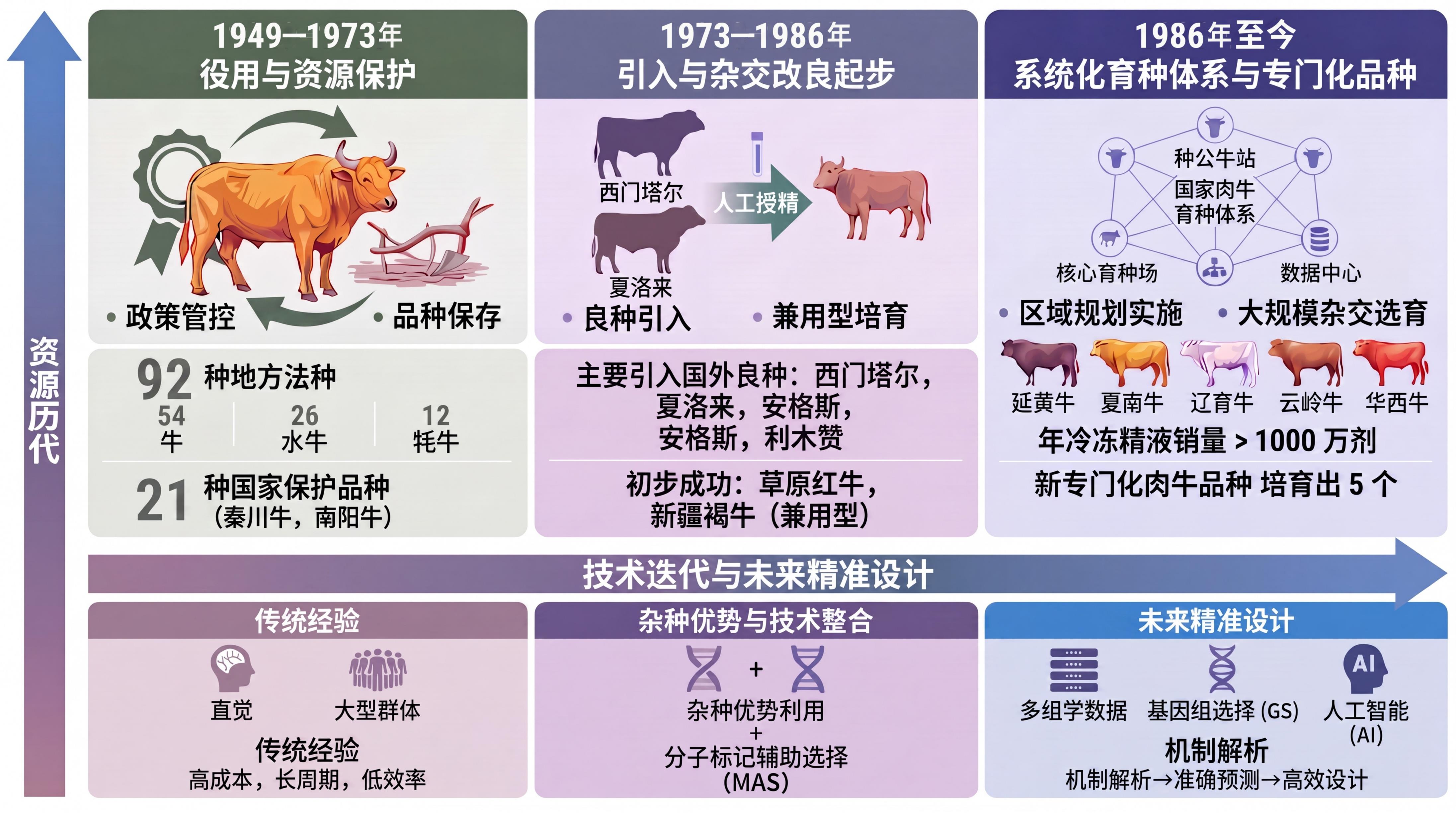
中国肉牛杂交育种的发展历程、现状与技术路径[35-36]"

表1

我国自主培育的五个主要肉牛品种"

品种名称

Cultivar name

育成时间

Release time

育种素材

Parental combination

核心优势性状

Main advantageous traits

杂交方式

Crossing scheme

夏南牛

Xianan cattle

2007年

父本:夏洛来

母本:南阳牛

生长快、产肉率高、适应性强、高繁殖力 导入杂交、横交固定与自群繁育三个阶段

延黄牛

Yanhuang cattle

2008年

父本:利木赞

母本:延边黄牛

生长快、产肉率高、肉质优异、繁殖力好、抗寒性强 系统杂交、回交与横交固定

辽育白牛

Liaoyu White cattle

2010年

父本:夏洛来

母本:辽宁黄牛

体型大、生长快、产肉性能优、抗寒性强 级进杂交后开展横交固定

云岭牛

Yunling cattle

2014年

父本:莫累灰、婆罗门

母本:云南黄牛

生长速度快、早熟、肉质优、繁殖力高、耐热抗蜱 三元杂交后横交固定

华西牛

Huaxi cattle

2021年

母本:蒙古牛、三河牛

父本:西门塔尔、夏洛来、利木赞

生产性能卓越、生长速度突出、广适性、遗传性能稳定、繁殖性能良好 杂交筛选→种质创新→横交固定
[1]
SHULL G H. Duplicate genes for capsule-form in Bursa bursa-pastoris[J]. Zeitschrift für Induktive Abstammungs- und Vererbungslehre, 1914, 12(1): 97-149.
[2]
DARWIN C, FIRM J M, SONS W C A, et al. The effects of cross and self fertilisation in the vegetable Kingdom[M]. London: John Murray, Albemarle Street, 1878.
[3]
SHULL G H. The composition of a field of maize[J]. Journal of Heredity, 1908, os-4(1): 296-301.
[4]
EAST E M. Inbreeding in corn[R]. Storrs: Report of the Connecticut Agricultural Experiment Station, 1908: 419-428.
[5]
林钰燕. 肉牛杂交育种研究现状与发展趋势[J]. 今日畜牧兽医, 2025, 41(11): 61-64.
LIN Y Y. Research Status and development trend of crossbreeding in beef cattle[J]. Today Animal Husbandry and Veterinary Medicine, 2025, 41(11): 61-64.
[6]
王继豪, 李建坤. 肉牛品种杂交优势及应用效果研究[J]. 吉林畜牧兽医, 2026, 47(5):4-6.
WANG J H, LI J K. Study on heterosis of beef cattle breeds and its application effects[J]. Jilin Animal Husbandry and Veterinary Medicine, 2026, 47(5):4-6.
[7]
DAVENPORT C B. Degeneration, albinism and inbreeding[J]. Science, 1908, 28(718): 454-455.
[8]
BRUCE A B. The Mendelian theory of heredity and the augmentation of vigor[J]. Science, 1910, 32(827): 627-628.
[9]
JONES D F. Dominance of linked factors as a means of accounting for heterosis[J]. Genetics, 1917, 2(5): 466-479.
[10]
MINVIELLE F. Dominance is not necessary for heterosis: a two-locus model[J]. Genetical Research, 1987, 49(3): 245-247.
[11]
Hay E H, Roberts A. Genomic Analysis of Heterosis in an Angus × Hereford Cattle Population [J]. Animals, 2023, 13(2): 191.
[12]
孙研研, 倪爱心, 杨涵涵, 等. 畜禽杂种优势形成机制与预测方法研究进展[J]. 中国农业科学, 2025, 58(5): 1017-1031.
SUN Y Y, NI A X, YANG H H, et al. Research progress on mechanisms interpretation and prediction methods for heterosis of livestock[J]. Scientia Agricultura Sinica, 2025, 58(5): 1017-1031.
[13]
李柏森. 安格斯牛与抗旱王牛及其杂交后代间耐热性能和白细胞转录组差异分析[D]. 重庆: 西南大学, 2020.
LI B S. Analysis of differences in heat resistance and leukocyte transcriptome between angus and droughtmaster and their hybrids[D]. Chongqing: Southwest University, 2020.
[14]
LI J Q, XU L, LIANG X Y, et al. A multi-tissue atlas of allelic-specific expression reveals the characteristics, mechanisms, and relationship with dominant effects in cattle[J]. BMC Biology, 2025, 23(1): 148.
[15]
LANDRY C R, HARTL D L, RANZ J M. Genome clashes in hybrids: insights from gene expression[J]. Heredity, 2007, 99(5): 483-493.
[16]
SCASCITELLI M, COGNET M, ADAMS K L. An interspecific plant hybrid shows novel changes in parental splice forms of genes for splicing factors[J]. Genetics, 2010, 184(4): 975-983.
[17]
朱家华, 沈俊男, 伊旭东, 等.杂种优势形成机制和预测方法及其在猪生产中的应用与展望[J]. 遗传, 2024, 46(8): 627-639.
ZHU J H, SHEN J N, YI X D, et al. Heterosis formation mechanism, prediction methods, and their application and prospect in pig production[J]. Hereditas (Beijing), 2024, 46(8): 627-639.
[18]
LI C Y, GE M, LONG K R, et al. Mechanism of parent-of-origin effects revealed by multi-omic data in euro-Chinese hybrid pigs[J]. Nature Communications, 2025, 16: 7542.
[19]
PANSARE M, WALIA P, PATIL K, et al. Unravelling the genetic Enigma: exploring the molecular basis of heterosis[J]. International Journal of Environment and Climate Change, 2023, 13(9): 228-237.
[20]
万亚琴. DNA甲基化与肉牛杂种优势关系的初步研究[D]. 重庆: 西南大学, 2008.
WAN Y Q. Study on the Relationship between DNA Methylation and Heterosis in Beef Cattle[D]. Chongqing: Southwest University, 2008.
[21]
朱昌鸿. 普通牛与牦牛基因组遗传变异的鉴定与功能基因挖掘[D]. 重庆: 西南大学, 2022.
ZHU C H. Identification and function gene identification of genetic variations between common cattle and yak
genomes[D]. Chongqing: Southwest University, 2022.
[22]
李应生. 利用微卫星标记预测鸡的杂种优势[D]. 石河子: 石河子大学, 2007.
LI Y S. Study on Prediction of Heterosis of Partial Traits by Using Microsatellite Markers[D]. Shihezi: Shihezi University, 2007.
[23]
范婷婷, 王文翔, 马毅, 等. 西门塔尔牛、和牛与荷斯坦牛杂种优势预测及实际杂交效果分析[J]. 畜牧兽医学报, 2022, 53(8): 2568-2577.
FAN T T, WANG W X, MA Y, et al. Prediction and effect analysis of heterosis in Simmental, wagyu and Holstein[J]. Acta Veterinaria et Zootechnica Sinica, 2022, 53(8): 2568-2577.
[24]
BARBOSA A M M, GERALDI I O, BENCHIMOL L L, et al. Relationship of intra- and interpopulation tropical maize single cross hybrid performance and genetic distances computed from AFLP and SSR markers[J]. Euphytica, 2003, 130(1): 87-99.
[25]
李超杰. 山西地方牛品种保种群群体遗传结构分析及分子系谱构建[D]. 太谷: 山西农业大学, 2024.
LI C J. Genetic structure analysis and molecular pedigree construction of Shanxi local cattle breeds[D]. Taigu: Shanxi Agricultural University, 2024.
[26]
皇甫芮瑶. 贵州威宁牛基因组遗传多样性与种质资源保护策略研究[D].杨凌: 西北农林科技大学, 2025.
HUANGFU R Y. Research on genomic genetic diversity and conservation strategies of weining cattle breeds in guizhou province[D]. Yangling: Northwest A&F University, 2025.
[27]
AKANNO E C, ABO-ISMAIL M K, CHEN L H, et al. Modeling heterotic effects in beef cattle using genome-wide SNP-marker genotypes[J]. Journal of Animal Science, 2018, 96(3): 830-845.
[28]
AKANNO E C, CHEN L H, ABO-ISMAIL M K, et al. Genome-wide association scan for heterotic quantitative trait loci in multi-breed and crossbred beef cattle[J]. Genetics Selection Evolution, 2018, 50(1): 48.
[29]
范婷婷, 陈燕, 张路培, 等. 西门塔尔牛与我国地方黄牛的杂种优势预测分析[J]. 畜牧兽医学报, 2021, 52(3): 653-661.
FAN T T, CHEN Y, ZHANG L P, et al. Prediction of heterosis between Chinese Simmental beef cattle and Chinese local cattle[J]. Acta Veterinaria et Zootechnica Sinica, 2021, 52(3): 653-661.
[30]
范婷婷. 基于高密度芯片开展牛杂种优势预测及相关基因鉴定[D]. 北京: 中国农业科学院, 2021.
FAN T T. Prediction and Related-Gene Identification of Heterosis in Cattle Based on High Density Chip[D]. Beijing: Chinese Academy of Agricultural Sciences, 2021.
[31]
XU L, NIU Q H, CHEN Y, et al. Validation of the prediction accuracy for 13 traits in Chinese Simmental beef cattle using a preselected low-density SNP panel[J]. Animals, 2021, 11(7): 1890.
[32]
ROSTAMZADEH MAHDABI E, TIAN R G, TIAN J, et al. Uncovering genomic diversity and signatures of selection in red Angus × Chinese red steppe crossbred cattle population[J]. Scientific Reports, 2025, 15: 12977.
[33]
GENG X L, QU Y J, JIA Y H, et al. Assessment of heterosis based on parental genetic distance estimated with SSR and SNP markers in upland cotton (Gossypium hirsutum L.)[J]. BMC Genomics, 2021, 22(1): 123.
[34]
MINVIELLE F, COVILLE J L, KRUPA A, et al. Genetic similarity and relationships of DNA fingerprints with performance and with heterosis in Japanese quail lines from two origins and under reciprocal recurrent or within-line selection for early egg production[J]. Genetics Selection Evolution, 2000, 32(3): 289.
[35]
杨武才, 杨本顺, 刘文杰, 等. 中国黄牛保种、选育及产业化利用现状与发展建议[J]. 中国畜禽种业, 2026, 22 (6): 1-11.
YANG W C, YANG B S, LIU W J, et al. Current status and development recommendations of conservation, breeding, and industrial utilization of Chinese yellow cattle[J]. The Chinese Livestock and Poultry Breeding, 2026, 22 (6): 1-11.
[36]
昝林森. 国际肉牛育种进展对我国地方黄牛遗传改良的启示[J]. 中国畜禽种业, 2026, 22(8): 10-18.
ZAN L S. International advances in beef cattle breeding as a reference for the genetic improvement of indigenous yellow cattle[J]. Chinese Livestock and Poultry Breeding, 2026, 22(8): 10-18.
[37]
李鹏飞, 茹宝瑞, 祁兴磊, 等. 夏南牛的培育[J]. 中国牛业科学, 2008, (3): 91-92.
LI P F, RU B R, QI X L. Breeding of Xianan Cattle[J]. China Cattle Science, 2008, (3): 91-92.
[38]
冯豆, 贺倩倩, 胡瑞, 等. 夏南牛基因组选择需求及机器学习在牛育种中的应用进展[J]. 中国牛业科学, 2026, 52(1): 52-61, 68.
FENG D, HE Q Q, HU R, et al. Genomic Selection Requirements for Xianan Cattle and Advances in the Application of Machine Learning in Cattle Breeding[J]. China Cattle Science, 2026, 52(1): 52-61, 68.
[39]
GAO Z, LU Y, CHONG Y, et al. Beef cattle genome project: advances in genome sequencing, assembly, and functional genes discovery[J]. International Journal of Molecular Sciences. 2024, 25(13): 7147.
[40]
张继川, 黄秉周, 吕福玉. 延黄牛-中国第二个肉用型牛品种培育成功[J]. 中国牛业科学, 2009, 35(3): 25-26.
ZHANG J C, HUANG B Z, LV F Y. Yanhuang breed-the second beef breed in china[J]. China Cattle Science, 2009, 35(3): 25-26.
[41]
赵文军. 延黄牛MDM2基因结构分析及其对脂代谢的影响[D]. 延吉: 延边大学, 2024.
ZHAO E J. Structural analysis of MDM2 gene and its effect on lipid metabolism in Yanhuang cattles[D]. Yanji: Yanbian University, 2024.
[42]
董玉影, 孙晓龙, 金颖, 等. 延边黄牛产业发展的思考与展望[J]. 肉类研究, 2014, 28(6): 30-33.
DONG Y Y, SUN X L, JIN Y, et al. Yellow cattle industry in Yanbian, Northeast China’s Jilin Province: development and prospects[J]. Meat Research, 2014, 28(6): 30-33.
[43]
刘军. 辽育白牛的品种特点、肥育饲养要点及应用前景[J]. 饲料博览, 2022(4): 32-35, 38.
LIU J. Breed characteristics, fattening and feeding points and application prospect of Liaoyu white cattle[J]. Feed Review, 2022(4): 32-35, 38.
[44]
杜学海. 辽育白牛选育与生产技术研究进展[J]. 现代畜牧兽医, 2024,(12):86-90.
DU X H. Research progress in breeding and production technology of Liaoyu white cattle[J]. Modern Journal of Animal Husbandry and Veterinary Medicine, 2024,(12):86-90.
[45]
李静, 杨术环, 尤佳, 等. 辽育白牛选育进展研究[J]. 中国畜禽种业, 2026, 22(8): 96-102.
LI J, YANG S H, YOU J, et al. Research on Breeding Advancements in Liaoyu White Cattle[J]. Chinese Livestock and Poultry Breeding, 2026, 22(8): 96-102.
[46]
马波. 我自主培育出三元杂交肉牛新品种[N]. 科技日报, 2015-02-17(001).
MA B. China independently develops a new three‑way crossbred beef cattle breed[N]. Science and Technology, 2015-02-17(001).
[47]
吴梦霞, 李天平, 李石友, 等. 云岭牛产业化发展现状及建议[J]. 养殖与饲料, 2017, 16(8): 103-104.
WU M X, LI T P, LI S Y, et al. Current situation and suggestions on industrialized development of yunling cattle[J]. Animals Breeding and Feed, 2017, 16(8): 103-104.
[48]
党栋. 基于拷贝数变异的南阳牛和云岭牛遗传变异研究[D]. 昆明: 云南农业大学, 2025.
DANG D. Research on Genetic Variation of Nanyang Cattle and Yunling Cattle Based on Copy Number Variation[D]. Kunming: Yunnan University, 2025.
[49]
高志民. 李俊雅:43年育成“华西牛”[N]. 人民政协报, 2022-08-18(7).
GAO Z M, LI J Y: 43 years to breed “Huaxi Cattle” [N]. People's Political Consultative Daily, 2022-08-18(7).
[50]
张天留, 王泽昭, 朱波, 等. 华西牛新品种培育及对我国肉牛育种的启示[J]. 吉林农业大学学报, 2023, 45(4): 385-390.
ZHANG T L, WANG Z Z, ZHU B, et al. Cultivation of new Huaxi cattle varieties and its enlightenment to beef cattle breeding in China[J]. Journal of Jilin Agricultural University, 2023, 45(4): 385-390.
[51]
王海, 余道宁, 张纯, 等. 华西牛育种技术创新与产业化推广研究[J]. 中国畜禽种业, 2026, 22(6): 38-44.
WANG H, YU D N, ZHANG C, et al. Research on innovation and industrialization of breeding technology of Huaxi cattle[J]. Chinese Livestock and Poultry Breeding, 2026, 22(6): 38-44.
[52]
尹万林, 孙亮亮, 李燕丽, 等. 秦川牛三元杂交代育肥效果分析[C]. //中国科学技术协会, 陕西省人民政府. 第十八届中国科协年会-分14西北地区农牧结合发展草牧业研讨会论文集. 2016: 341-344.
YING W L, SUN L L, LI Y L, et al. The fattening effect analysis of three-way crossbred Qinchuan cattle[C]. //Proceedings of the Symposium on Integrated Crop-Livestock System for Grassland Agriculture Development in Northwest China, Sub-forum 14 of the 18th Annual Meeting of the China Association for Science and Technology, 2016: 341-344.
[53]
闫伟, 罗玉柱, 李少斌, 等. 不同杂交组合肉牛产肉性能比较分析[J].中国牛业科学, 2016, 42(1):18-22.
YAN W, LUO Y Z, LI S B, et al. Comparative analysis of meat production performance of beef cattle with different crossbreeding combinations. China Cattle Science[J], 2016, 42(1):18-22.
[54]
胡宏伟, 杜宝强, 张成虎. 秦川牛与不同品种肉牛杂交F1代生长性能比较研究[J]. 甘肃畜牧兽医, 2022, 52(8): 20-23, 34.
HU H W, DU B Q, ZHANG C H. Comparative study on growth performance of F1 crossbreds between Qinchuan cattle and different beef cattle breeds[J]. Gansu Animal and Veterinary Sciences, 2022, 52(8): 20-23, 34.
[1] 昝林森. 国际肉牛育种进展对我国地方黄牛遗传改良的启示[J]. 中国畜禽种业, 2026, 22(8): 10-18.
[2] 曹晓瑶, 李姣, 王亭, 熊兰玲, 蔡向庭, 冯思远, 王泽昭, 郑彩宏, 陈燕, 张路培, 高雪, 高会江, 朱波, 李俊雅. 中国肉牛遗传改良研究进展与未来展望:从“追赶”到“创新”的种业振兴之路[J]. 中国畜禽种业, 2026, 22(8): 19-31.
[3] 喇永富, 梁春年. 牦牛繁育关键技术创新应用、挑战及对策[J]. 中国畜禽种业, 2026, 22(8): 32-41.
[4] 鲍迪, 孙铭, 秦立红. 吉林省肉牛遗传改良研究进展[J]. 中国畜禽种业, 2026, 22(8): 42-47.
[5] 王宏浩, 刘彦杰, 张元庆. 山西肉牛育种:聚焦“太行云牛”的遗传改良实践[J]. 中国畜禽种业, 2026, 22(8): 48-53.
[6] 彭朋, 刘廷玉, 赵慧峰, 赵博伟, 李素霞, 徐华, 李树静, 王昆. 河北省肉牛遗传改良现状、存在的问题及发展建议[J]. 中国畜禽种业, 2026, 22(8): 54-60.
[7] 冯豆, 邓红雨, 王利宁, 姚嘉伦, 贺磊, 全清华, 贺倩倩, 张震. 河南省肉牛发展现状及策略研究[J]. 中国畜禽种业, 2026, 22(8): 61-67.
[8] 杨武才, 杨本顺, 刘文杰, 周正海, 谭建兵, 孔贤亚, 昝林森. 中国黄牛保种、选育及产业化利用现状与发展建议[J]. 中国畜禽种业, 2026, 22(8): 79-89.
[9] 陈伟生, 李立望, 彭华. 我国肉牛业发展现状、历史演进与未来发展路径研究[J]. 中国畜禽种业, 2026, 22(6): 10-17.
[10] 陈宏. 中国地方黄牛品种的选育与杂交利用[J]. 中国畜禽种业, 2026, 22(6): 18-24.
[11] 缪立生, 汪聪勇, 曹阳, 赵玉民. 肉牛种业发展及遗传改良路径[J]. 中国畜禽种业, 2026, 22(6): 25-30.
[12] 张聪聪, 刘洪亮, 王珺, 任清丹, 罗晓彤, 李轩宇, 李春宇, 刘基伟, 朱永超, 吴健. 吉林省肉牛遗传改良举措及共性问题的思考与建议[J]. 中国畜禽种业, 2026, 22(6): 31-37.
[13] 王海, 余道宁, 张纯, 褚倩倩, 赵军均, 张岱阳, 汪聪勇. 华西牛育种技术创新与产业化推广研究[J]. 中国畜禽种业, 2026, 22(6): 38-44.
[14] 闫向民, 耿娟, 杨光维, 马桢, 高亮, 刘建明, 黄锡霞. 新疆肉牛遗传改良的科技革新路径与体系化新实践[J]. 中国畜禽种业, 2026, 22(6): 45-52.
[15] 刘凤娟, 吴铁成, 刘俊阳, 王涛, 意乐其, 高玉林, 闫新刚, 刘斌. 家畜基因组选种选配技术的研究进展[J]. 中国畜禽种业, 2026, 22(5): 70-78.
Viewed
Full text


Abstract

Cited

  Shared   
  Discussed   
No Suggested Reading articles found!