v

Chinese Livestock and Poultry Breeding ›› 2026, Vol. 22 ›› Issue (5): 11-20.doi: 10.19543/j.cnki.1673-4556.20260427.002cstr: 32418.14.j.cnki.1673-4556.20260427.002

• Advanced Technology • Previous Articles     Next Articles

Factors affecting the accuracy of INDEL genotype imputation in pigs

Xiaoxiao Yin(), Jiete Liang, Jinyu Chu, Xinyun Li, Yunlong Ma()   
  1. College of Animal Science and Technology, College of Veterinary Medicine, Huazhong Agricultural University, Wuhan, 430070, Hubei
  • Received:2025-11-01 Online:2026-03-26 Published:2026-06-17
  • Contact: Yunlong Ma E-mail:xiaoxiao.yin@webmail.hzau.edu.cn;Yunlong.Ma@mail.hzau.edu.cn

Abstract:

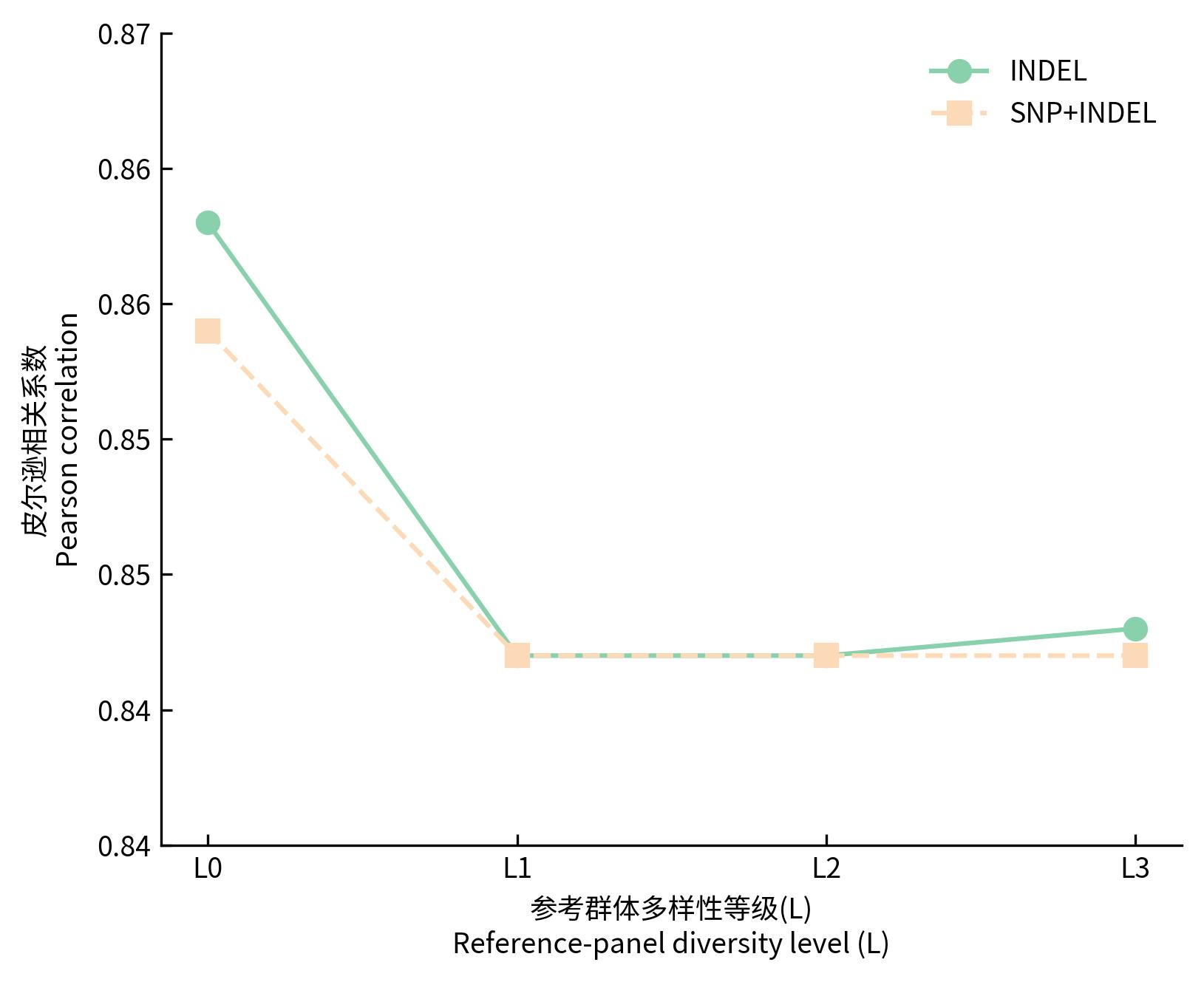
Objective This study investigated genotype imputation for porcine insertions/deletions to evaluate the effects of different factors on imputation accuracy and to identify an optimal imputation strategy. Method Based on whole-genome sequencing data from 1119 pigs, two reference panels were constructed: reference panel I containing only INDEL genotypes and reference panel II containing both SNP and INDEL genotypes. Two hundred Large white pigs were selected as the validation population. Autosomal INDEL genotypes were masked chromosome by chromosome under a completely random scheme at five missing proportions (20%, 45%, 70%, 95%, and 99%) to simulate different marker densities. Five reference panel sizes (10, 50, 100, 500, and 1000) and seven minor allele frequency (MAF) intervals ([0.01, 0.03), [0.03, 0.05), [0.05, 0.1), [0.1, 0.2), [0.2, 0.3), [0.3, 0.4), and [0.4, 0.5]) were set. In addition, using 100 Large white pigs as the core population, four reference panel diversity levels (L0-L3) were established by introducing other pig breeds. The INDEL imputation accuracy of Beagle 5.5, IMPUTE 5, and Minimac 3 was compared using concordance rate (CR) and pearson correlation coefficient (PC). Result Under all tested conditions, reference panel I showed higher imputation accuracy than reference panel II, with mean PC values of 0.797 and 0.760, respectively. In reference panel I, the PC values of Beagle 5.5 and IMPUTE 5 decreased from 0.898 and 0.900 at 20% missingness to 0.641 and 0.640 at 99% missingness, respectively, whereas the PC value of Minimac 3 was only 0.481 at 99% missingness. The PC value of Beagle 5.5 increased from 0.619 at a reference panel size of 10 to 0.794 at 100, but increased only to 0.832 at 1000. When MAF increased from 0.01~0.03 to 0.4~0.5, the PC value of Beagle 5.5 increased from 0.571 to 0.837. The PC value at L0 was 0.863, which was higher than those at L1, L2, and L3 (0.847, 0.847, and 0.848, respectively). Conclusion In summary, the inclusion of SNPs in the reference panel reduced the accuracy of INDEL imputation. As marker density decreased, imputation accuracy also declined. Beagle 5.5 and IMPUTE 5 were both suitable for porcine INDEL imputation, whereas Minimac 3 performed poorly under extremely low marker density. Imputation accuracy increased with reference panel size, but the gain in accuracy from additional samples became markedly weaker once the reference panel size reached about 100 individuals. The L0 level, which was genetically most consistent with the validation population, showed the highest accuracy. For porcine INDEL genotype imputation, it is recommended to use data with relatively high marker density, and a reference panel size of about 100 individuals is suggested. An MAF threshold of >0.05 is recommended as a quality-control criterion for imputed INDEL genotypes. When the reference panel consists of multiple breeds, populations with genetic backgrounds similar to that of the validation population should be selected whenever possible. Choosing appropriate software while considering both computational efficiency and imputation accuracy remains critical for ensuring reliable results. This study provides a reference for optimizing porcine INDEL genotype imputation strategies and offers a methodological basis for the genetic dissection of complex traits and breeding applications based on INDEL variation.

Key words: Pig, Marker density, Reference panel size, Minor allele frequency, Reference panel diversity, INDEL genotype imputation

CLC Number: 

  • S828

Table 1

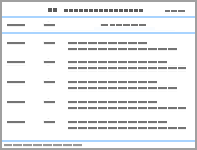
Experimental design for evaluating the genetic diversity of the reference population"

品种Breed多样性等级Diversity level
L0L1L1L1L2L2L2L2L2L2L3
大白猪Large white pig175100100100100100100100100100100
杜洛克猪Duroc pig07500505025025025
中国地方猪种Chinese native pig00750250505002525
欧洲地方猪种European native pig00075025025505025

Fig. 1

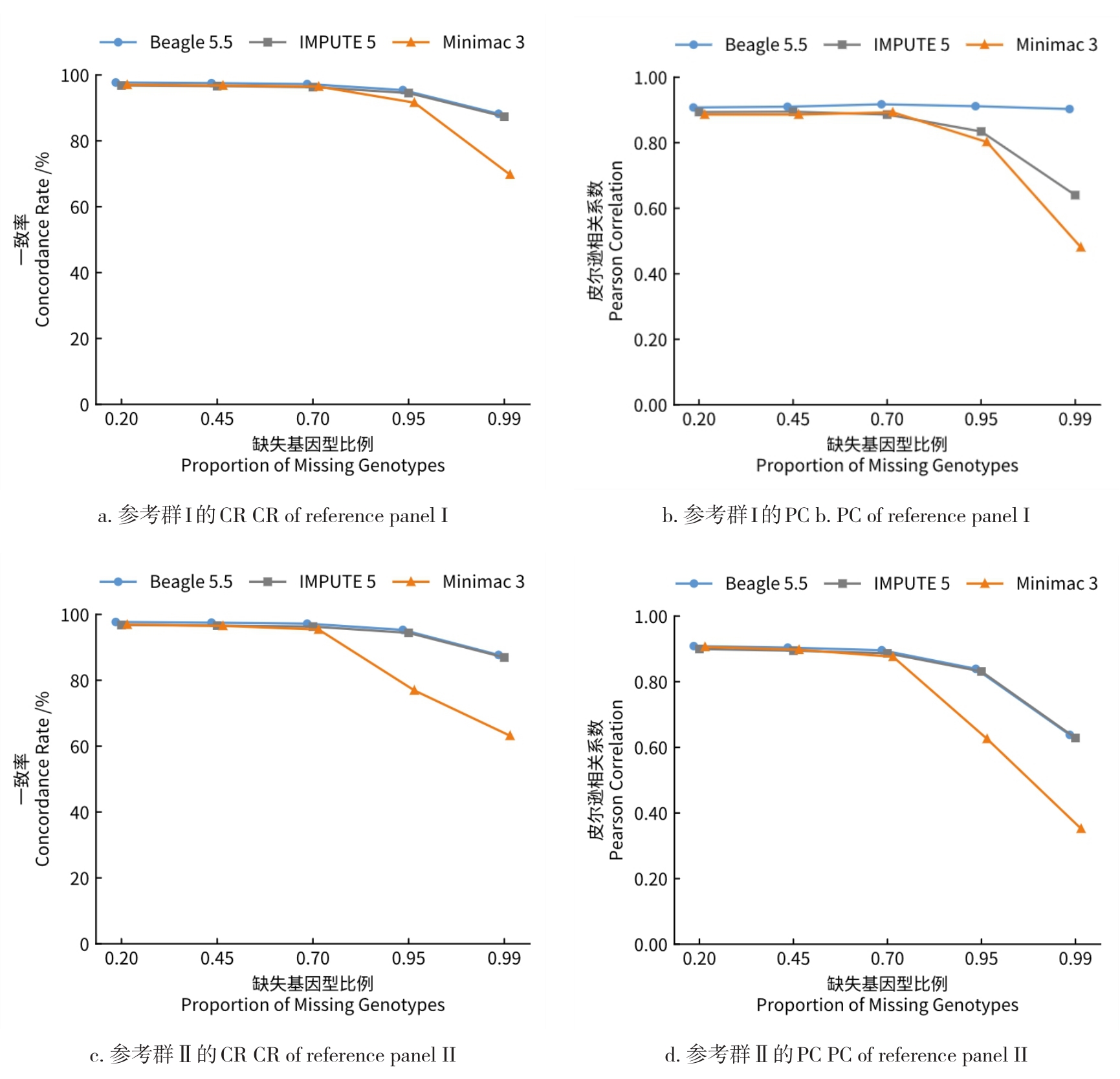
Effect of genotype missingness level on the accuracy of INDEL genotype imputationNote: Reference panels I and II represent the panel containing only INDEL genotypes and the panel containing both SNP and INDEL genotypes, respectively. CR denotes concordance rate, and PC denotes the Pearson correlation coefficient. The same applies below."

Fig. 2

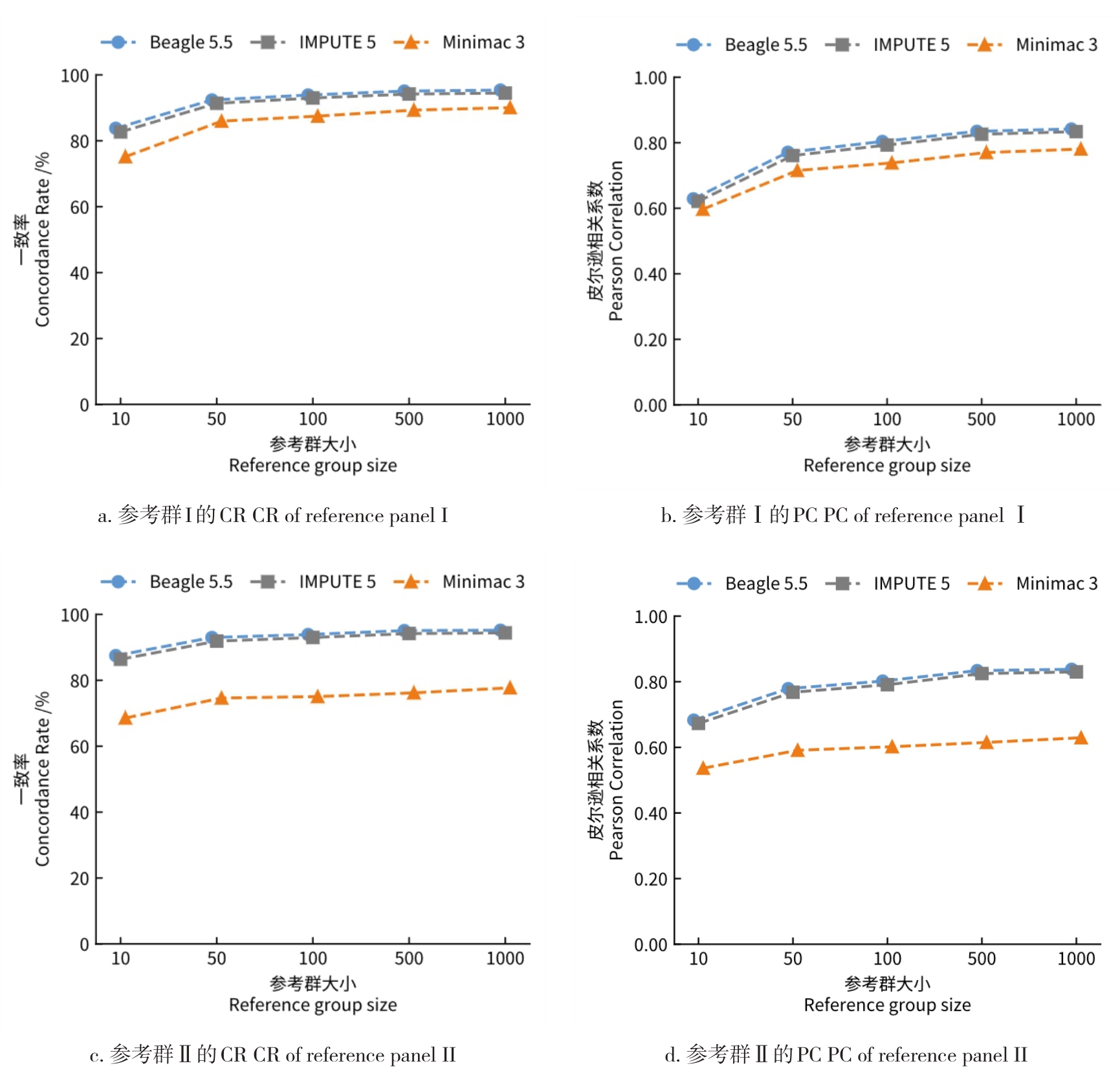
Effect of reference panel size on INDEL genotype imputation accuracy"

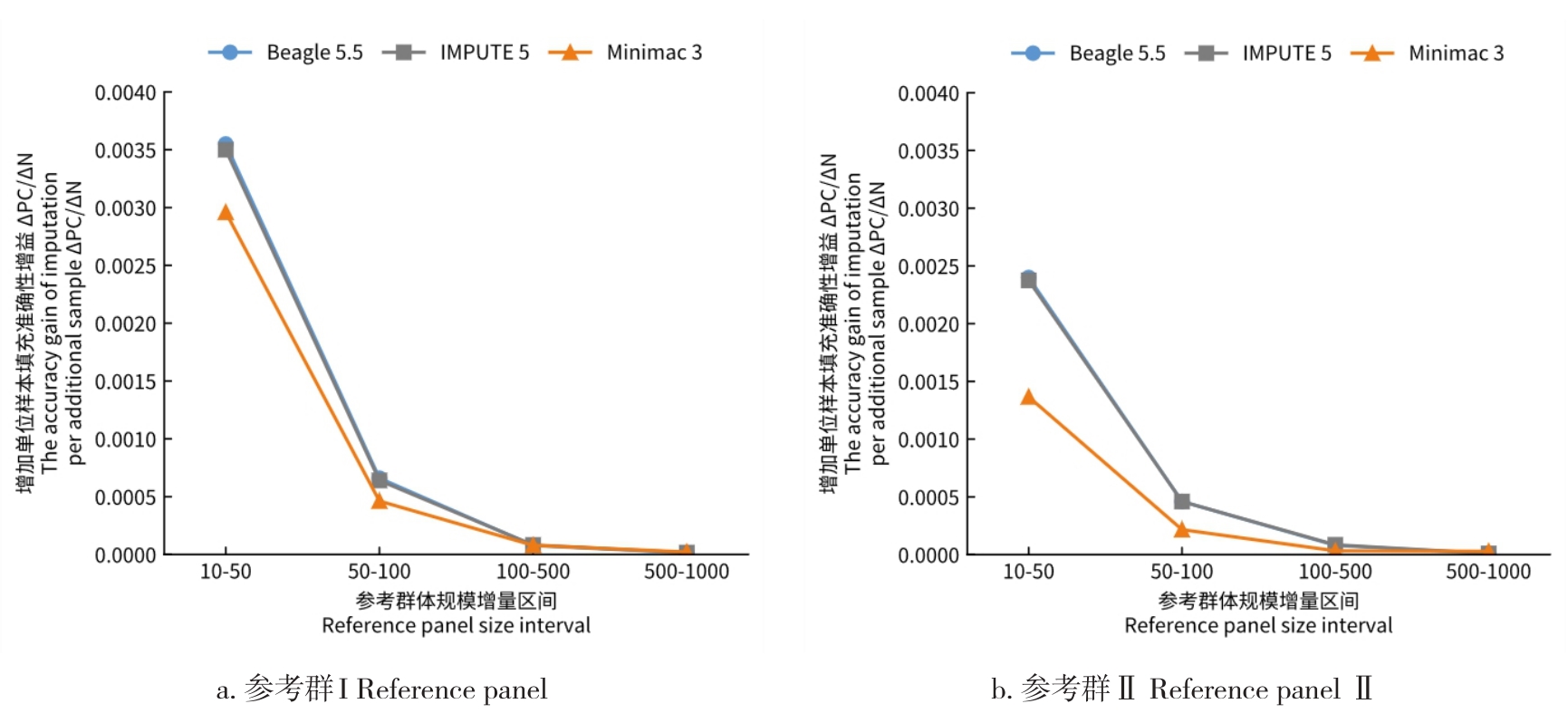
Fig.3

The accuracy gain of imputation under incremental reference population size intervals(ΔPC/ΔN)"

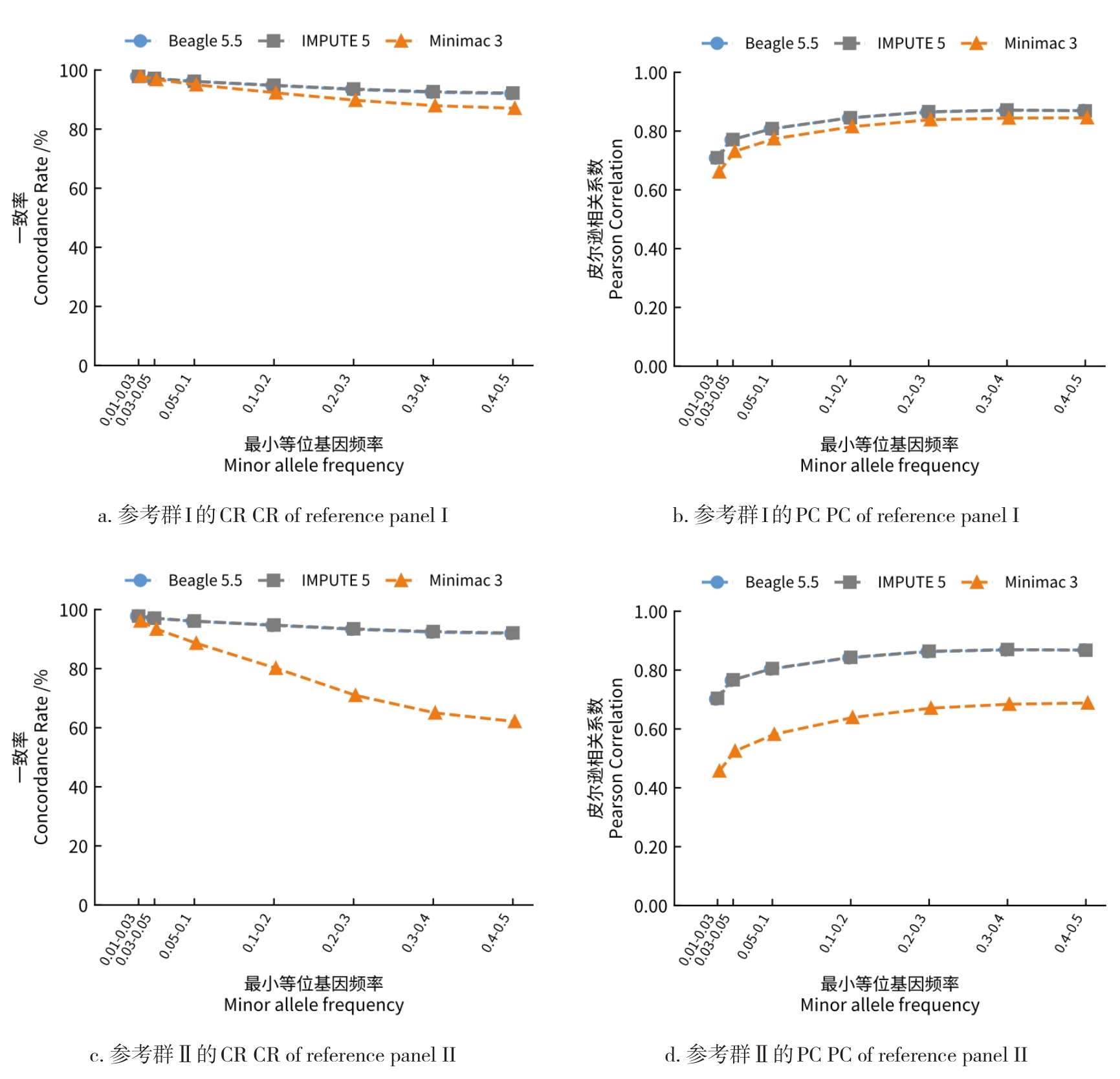
Fig. 4

Accuracy of INDEL genotype imputation across different MAF intervals"

Fig. 5

Imputation accuracy of reference panels with different diversity levels"

[1] MARCHINI J, HOWIE B, MYERS S, et al. A new multipoint method for genome-wide association studies by imputation of genotypes[J]. Nature Genetics, 2007, 39(7): 906-913.
[2] HOWIE B N, DONNELLY P, MARCHINI J. A flexible and accurate genotype imputation method for the next generation of genome-wide association studies[J]. PLoS Genetics, 2009, 5(6): e1000529.
[3] BROWNING B L, ZHOU Y, BROWNING S R. A one-penny imputed genome from next-generation reference panels[J]. A-merican Journal of human genetics, 2018, 103(3): 338-348.
[4] RUBINACCI S, DELANEAU O, MARCHINI J. Genotype imputation using the positional burrows wheeler transform[J]. PLoS Genetics, 2020, 16(11): e1009049.
[5] DAS S, FORER L, SCHÖNHERR S, et al. Next-generation genotype imputation service and methods[J]. Nature Genetics, 2016, 48(10): 1284-1287.
[6] NGUYEN T V, BOLORMAA S, REICH C M, et al. Empirical versus estimated accuracy of imputation: optimising filtering thresholds for sequence imputation[J]. Genetics Selection Ev-olution, 2024, 56(1): 72.
[7] LEE D, KIM Y, CHUNG Y, et al. Accuracy of genotype imputation based on reference population size and marker density in Hanwoo cattle[J]. Journal of Animal Science and Technology, 2021, 63(6): 1232-1246.
[8] COSTA HERMISDORFF I DA, COSTA R B, DE ALBUQUERQUE L G, et al. Investigating the accuracy of imputing autosomal variants in Nellore cattle using the ARS-UCD1.2 assembly of the bovine genome[J]. BMC Genomics, 2020, 21(1): 772.
[9] ZHANG K L, PENG X, ZHANG S X, et al. A comprehensive evaluation of factors affecting the accuracy of pig genotype imputation using a single or multi-breed reference population[J]. Journal of Integrative Agriculture, 2022, 21(2): 486-495.
[10] MULLANEY J M, MILLS R E, PITTARD W S, et al. Small insertions and deletions (INDELs) in human genomes[J]. Human Molecular Genetics, 2010, 19(R2): R131-R136.
[11] XU J Y, FU Y H, HU Y, et al. Whole genome variants across 57 pig breeds enable comprehensive identification of genetic signatures that underlie breed features[J]. Journal of Animal Science and Biotechnology, 2020, 11(1): 115.
[12] ROY M E, MANOJ M, ROJAN P M, et al. Identification of genetic variants by whole genome sequencing in Ankamali pigs of Kerala [J]. Journal of Veterinary and Animal Sciences, 2023, 54(2): 524-531.
[13] FANG H, WU Y Y, NARZISI G, et al. Reducing INDEL calling errors in whole genome and exome sequencing data[J]. Genome Medicine, 2014, 6(10):89.
[14] PURCELL S, NEALE B, TODD-BROWN K, et al. PLINK: a tool set for whole-genome association and population-based linkage analyses[J]. American Journal of Human Genetics, 2007, 81(3): 559-575.
[15] CHANG C C, CHOW C C, TELLIER L C, et al. Second-generation PLINK: rising to the challenge of larger and richer datasets[J]. GigaScience, 2015, 4: 7.
[16] HOFMEISTER R J, RIBEIRO D M, RUBINACCI S, et al. Accurate rare variant phasing of whole-genome and whole-exome sequencing data in the UK Biobank[J]. Nature Genetics, 2023, 55(7): 1243-1249.
[17] DING R R, SAVEGNAGO R, LIU J D, et al. The SWine IMputation (SWIM) haplotype reference panel enables nucleoti-de resolution genetic mapping in pigs[J]. Communications Biol-ogy, 2023, 6: 577.
[18] ZHANG K L, LIANG J T, FU Y H, et al. AGIDB: a versatile database for genotype imputation and variant decoding across species[J]. Nucleic Acids Research, 2024, 52(D1): D835-D849.
[19] ULLAH E, MALL R, ABBAS M M, et al. Comparison and assessment of family- and population-based genotype imputat-ion methods in large pedigrees[J]. Genome Research, 2019, 29(1): 125-134.
[20] TONG X K, CHEN D, HU J C, et al. Accurate haplotype construction and detection of selection signatures enabled by high quality pig genome sequences[J]. Nature Communications, 2023, 14: 5126.
[21] WANG Q Y, ZHANG Z Y, YE X W, et al. An updated Pig Haplotype Reference Panel (PHARP 4.0) comprising 13, 298 haplotypes[J]. Communications Biology, 2025, 8: 1625.
[22] CAI Z X, SARUP P, OSTERSEN T, et al. Genomic diversity revealed by whole-genome sequencing in three Danish commercial pig breeds[J]. Journal of Animal Science, 2020, 98(7):skaa229.
[23] CHEN L F, YANG S P, ARAYA S, et al. Genotype imputation for soybean nested association mapping population to improve precision of QTL detection[J]. Theoretical and Applied Genetics, 2022, 135(5): 1797-1810.
[24] HICKEY J M, CROSSA J, BABU R, et al. Factors affecting the accuracy of genotype imputation in populations from several maize breeding programs[J]. Crop Science, 2012, 52(2): 654-663.
[25] RAMNARINE S, ZHANG J, CHEN L S, et al. When does choice of accuracy measure alter imputation accuracy assessments[J]. PLoS One, 2015, 10(10): e0137601.
[26] CAHOON J L, RUI X Y, TANG E, et al. Imputation accuracy across global human populations[J]. The American Journal Of Human Genetics, 2024, 111(5): 979-989.
[27] LU J T, WANG Y, GIBBS R A, et al. Characterizing linkage disequilibrium and evaluating the imputation power of human genomic insertion-deletion polymorphisms[J]. Genome Biology, 2012, 13(2): R15.
[28] STAHL K, GOLA D, KÖNIG I R. Assessment of imputation quality: comparison of phasing and imputation algorithms in real data[J]. Frontiers in Genetics, 2021, 12: 724037.
[29] DE MARINO A, MAHMOUD A A, BOSE M, et al. A comparative analysis of current phasing and imputation software[J]. PLoS One, 2022, 17(10): e0260177.
[30] WANG X Q, WANG L G, SHI L Y, et al. Imputation strategies for low-coverage whole-genome sequencing data and their effects on genomic prediction and genome-wide association studies in pigs[J]. Animal, 2024, 18(9): 101258.
[31] DENG T Y, ZHANG P F, GARRICK D, et al. Comparison of genotype imputation for SNP array and low-coverage whole-genome sequencing data[J]. Frontiers in Genetics, 2022, 12: 704118.
[1] Ming Chen, Suiyuan Lin, Ming Chen, Xiaoyun Hou, Weifeng Chen, Shiqi Guo, Yinkai Zhan, Zeting Xie, Haoze Xu, Pufei Hong, Yuanhao Han, Hongqiu Yang, Kaiyue Chang, Zhongping Wu, Yitian Chen, Yayan Liang, Xumeng Zhang. Effects of different disinfection methods on sterilization and hatching performance of pigeon hatching eggs [J]. Chinese Livestock and Poultry Breeding, 2026, 22(5): 79-87.
[2] Changling Ke, Kui Cao, Jing Liu, Daibo Fu, Sijing Zeng, Jian Zhang, Gongxiu Yu, Yao Hu, Xiong Xiong, Shiming Xu, Quanyong Zhou. Performance testing of a hybridized combination between Duroc and Gannan Tibetan pig [J]. Chinese Livestock and Poultry Breeding, 2026, 22(5): 125-130.
[3] . A Preliminary study on the Egg-laying regularity of Production pigeons [J]. The Chinese Livestock and Poultry Breeding, 2023, 19(9): 57-63.
[4] Bai Hongjie. Information Management and Brand Building of Seed Enterprises in the Background of Strong Agricultural Province—Taking Henan NongKe Pig Breeding Technology Co., Ltd. as an example [J]. The Chinese Livestock and Poultry Breeding, 2023, 19(8): 106-110.
Viewed
Full text


Abstract

Cited

  Shared   
  Discussed   
No Suggested Reading articles found!