v

Chinese Livestock and Poultry Breeding ›› 2026, Vol. 22 ›› Issue (7): 92-100.doi: 10.19543/j.cnki.1673-4556.20260610.001cstr: 32418.14.j.cnki.1673-4556.20260610.001

;

• Breeding of New Varieties • Previous Articles    

Breeding of the Nongda No. 6 layer crossbreeding system

Shuo Li1(), Long Liu2, Tuoyu Geng2, Chuanwei Zheng3, Liang Chen1, Daoqing Gong2()   

  1. 1. Jiangsu Beinongda Agricultural and Animal Husbandry Technology Co. , Ltd. , Taizhou, 225500, Jiangsu
    2. Yangzhou University, Yangzhou, 225001, Jiangsu
    3. Beinongda Technology Co. , Ltd. , Beijing, 102211
  • Received:2025-12-13 Online:2026-07-26 Published:2026-07-18
  • Contact: Daoqing Gong E-mail:ydlishuo@163.com;yzgong@163.com

Abstract:

Objective To comply with the trend of independent innovation in China's layer breeding industry and the upgrading of pink-shell egg consumption, address the specific breeding needs of Jiangsu Province, and solve the problems of insufficient laying performance, high feed-to-egg ratio, poor uniformity, and low profitability of culled hens in existing specialty layer breeds, a three-line crossbreeding system of small-sized, green-footed, black-feathered pink-shell layers was developed. By utilizing a three-line mating pattern combining local chicken resources with high-yielding layers, this work aims to integrate high laying performance with specialty traits, enhance the competitiveness of Chinese layer breeds, meet the market demand for high-quality specialty eggs and high-value culled hens, and promote industrial efficiency and farmers' income. Method During the development of the "Nongda No.6" layer crossbreeding system, the terminal sire (line H) was bred based on the black-feathered green-footed local chicken of Dongtai, Jiangsu Province (derived from crossing the black-feathered Yuanbao chicken with the Guifei chicken). The slow-feathering line A (a maternal line of the "Nongda No.5" small-sized layer crossbreeding system) and the fast-feathering line K (a paternal line of the "Nongjin No.1" layer crossbreeding system), both of the Rhode Island Red standard breed, were introduced as the first sire and the maternal line, respectively. The breeding methods comprehensively integrated individual phenotypic selection, testcross selection (e.g., for black feather/green foot traits in line H and homozygosity for slow-feathering in line A), molecular marker-assisted selection (using the MC1R gene to screen for the black feather trait in line H), index selection (for egg number), and sib selection (for sex-limited traits in males). Through a multi-stage selection procedure from day-old chicks to 66 weeks of age (including avian leukosis and pullorum disease purification, semen quality testing, and egg quality measurement), key indicators such as feather color, shank color, body weight uniformity, age at first egg, egg number at 43 and 66 weeks, egg weight, eggshell strength, eggshell glossiness and color, Haugh unit, yolk ratio, fertilization and hatchability rates, as well as avian leukosis/pullorum positive rates were systematically measured for each line. The superior performance of the commercial generation, including pink-shell egg production, strong disease resistance, persistent laying peak, as well as the product advantages of high eggshell strength, moderate egg weight, shiny pink eggs, and high-quality black-feathered, green-footed, small-sized culled hens, was validated through pilot tests. Result The breeding results showed that the parental roosters of the "Nongda No.6" crossbreeding system are black-feathered, green-footed and fast-feathering, while the parental hens are dark red-feathered, yellow-footed and slow-feathering. After five generations of selection, the rates of black feather, green foot and fast-feathering in the terminal sire line H all reached 100%. The commercial generation chickens are black-feathered, green-footed and fast-feathering, and lay shiny pink-shell eggs. The egg number at 43 weeks was increased by 12.8 eggs in line H. The slow-feathering rate in the first sire line A reached 100%, and the egg number at 43 weeks was increased by 7.5 eggs. In the maternal line K, the egg weight at 43 weeks was reduced by 2.1 g, and the uniformity of eggshell color was improved. Through continuous disease purification, the positive rate of avian leukosis in line H decreased from 0.36% to 0.01%, while lines A and K, as well as all three lines for pullorum disease, became completely negative. In terms of production performance, the survival rate of commercial generation chickens from 0 to 18 weeks was over 98%, the number of eggs per hen housed at 72 weeks reached 282.7–284.7, the average egg weight was 50.3 g, the feed-to-egg ratio during the laying period was as low as 2.28∶1, and the eggshell strength at 43 weeks reached 4.08–4.51 kg/cm2, demonstrating comprehensive advantages including high egg production, low feed consumption, excellent egg quality and high residual value of culled hens. Conclusion The "Nongda No.6" layer crossbreeding system has successfully developed a specialty layer crossbreeding system characterized by high yield, superior quality and low input by integrating the black-feathered green-footed local chicken with the Rhode Island Red standard breed through systematic combining ability tests, pure line selection, molecular marker-assisted selection and disease purification. The Nongda No.6" not only aligns with the trends of the specialty consumer market but also meets the "two highs and one low" requirements of specialty layer farmers, i.e., low rearing cost for small to medium-sized hens, high egg price and high culled hen price. Therefore, it has broad prospects for promotion and application

Key words: "Nongda No.6" layer, Crossbreeding system, Breeding technology

CLC Number: 

  • S831

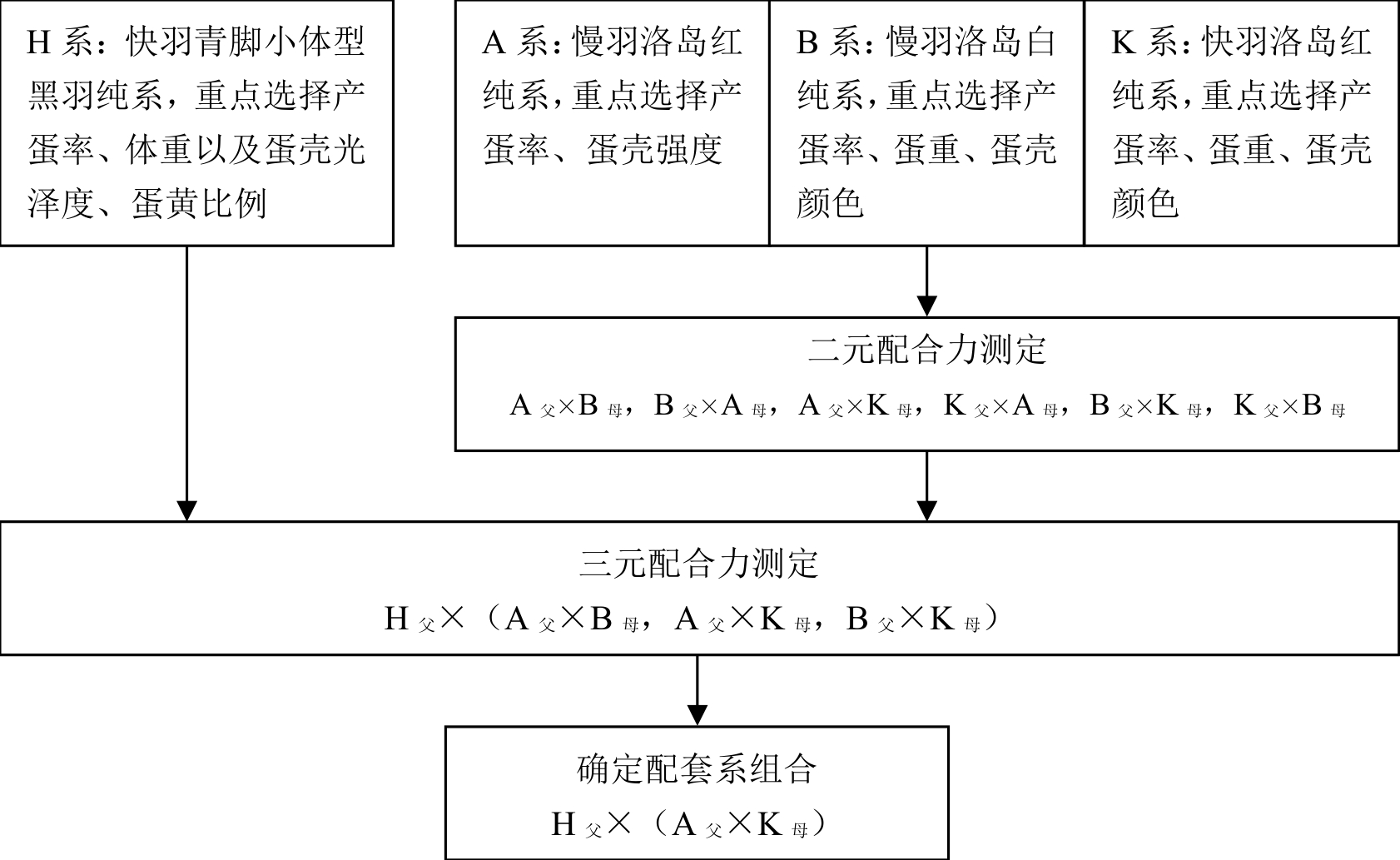
Fig. 1

Technology roadmap of determination of combining ability"

Table 1

Comparison of production performance between two-breed and three-breed cross combination"

项目Items 二元杂交Two-breed cross 三元杂交Three-breed cross
A×B B×A A×K K×A B×K K×B

H×

(A×B

H×

(A×K

H×

(B×K

初生重Body weight at first day/g 39.9 40.1 41.3 41 40.6 41.1 39.4 39.8 40.3
5周龄体重Body weight of 5 weeks/g 412.8 412.5 411.6 411.7 412.4 412 380.2 388.5 386.6
18周龄体重Body weight of 18 weeks/g 1670.7 1650.7 1650 1636.9 1697.1 1690.2 1558.7 1565.7 1580
72周龄体重Body weight of 72 weeks/g 1875.6 1872.9 1878.9 1875.1 1883.1 1884.2 1632.6 1660.9 1655.3
母鸡羽色Hen feather colour 红羽 白羽 红羽 红羽 白羽 红羽 黑羽+白羽 纯黑羽 黑羽+白羽
母鸡羽速Hen feather growth rat 慢羽 慢羽 慢羽 快羽 慢羽 快羽 快羽 快羽 快羽
育雏育成期成活率(0~18周龄)Survival rate during the hatching period(0-18 weeks)/% 97.2 96.1 96.7 95.8 96 95.8 96.6 97 97.1
产蛋期成活率(19~72周龄)Survival rate during egg laying period (19-72 weeks)/% 95.6 93.7 95.2 95.4 95.2 94.1 93.6 95.4 95.1
0~18周龄每只鸡累计耗料量Feed consumption(0-18 weeks)/kg 6.54 6.46 6.43 6.41 6.64 6.61 4.91 4.85 4.82
19~72周龄每只鸡累计耗料量Feed consumption(19-72 weeks)/kg 43.1 43.33 42.6 42.96 42.99 43.22 33.74 33.67 33.41
开产日龄Age at the first egg/d 143.4 142.7 144.2 143.8 142.4 142.1 145.4 143.7 146.2
饲养日产蛋量(19~72周龄)Daily egg production (19-72 weeks)/个 310 288 318 292 305 295 278.1 280.3 272.8
饲养日产蛋总重(19~72周龄)Total egg production weight (19-72 weeks)/kg 18.8 17.4 19.6 17.6 18.6 18 14.1 14.4 13.8
平均蛋重Average egg weight/g 60.7 60.5 61.6 60.4 61.1 60.9 50.7 51.5 50.6
产蛋期料蛋比(19~72周龄)Egg feed ratio during egg laying period (19-72 weeks) 2.29 2.49 2.17 2.44 2.31 2.41 2.39 2.33 2.42

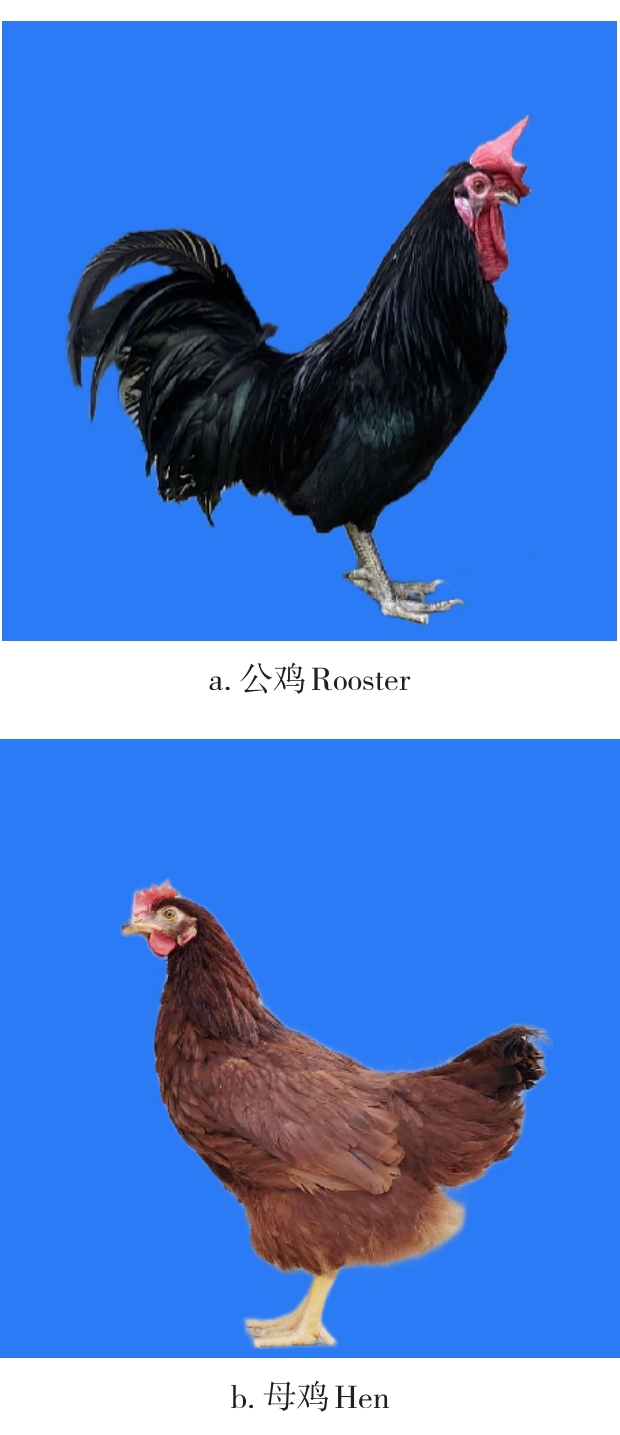
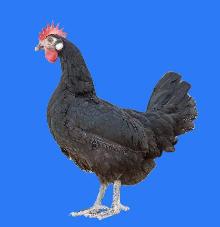
Fig. 2

Parent stock Note: The picture is from Jiangsu Beinongda Agriculture and Animal Husbandry Technology Co., Ltd. parent stock farm."

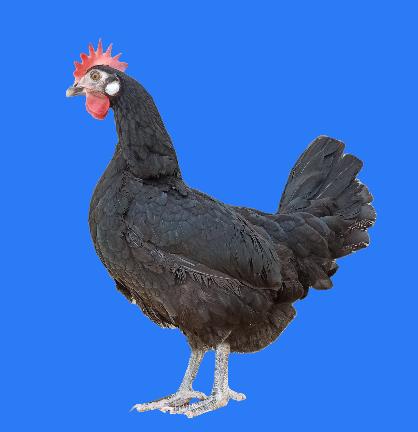
Fig. 3

Commercial hen Note: The picture comes from Dongtai Fish Rice Township Agricultural Products Co., Ltd. commercial chicken farm."

Table 2

Main production performance indexes of parent stock farm"

项目Items 数据Data
育雏育成期成活率Survival rate during the hatching period/% 97
产蛋期只鸡日耗料(19~72周龄)Daily feed consumption of chickens during egg laying period (19-72 weeks)/g 115
育雏育成期(0~18周龄)只鸡累计耗料Accumulated feed consumption of chicks during the incubation period (0-18 weeks)/kg 6.7
成年体重(43周龄)Adult body weight (43 weeks)/kg 1.7
达50%产蛋率日龄Age at 50% egg production rate/d 143~150
入舍鸡产蛋数(19~66周龄)Egg production of housed chickens (19-66 weeks)/个 276~286
饲养日产蛋数(19~66周龄)Daily egg production (19-66 weeks)/个 281~295
产蛋总重(19~66周龄)Total egg production weight (19-66 weeks)/kg 17.8~18.7
平均蛋重(19~66周龄)Average egg weight (19-66 weeks)/g 60.5~62.5
43周龄蛋壳强度43 week eggshell strength/(kg•cm-2) 4.0
产蛋期成活率(18~66周龄)Survival rate during egg laying period (18-66 weeks)/% >94
产蛋期料蛋比(18~66周龄)Egg feed ratio during egg laying period (18-66 weeks) 2.15:1
66周龄体重Weight at 66 weeks of age/kg 1.9~2.2
合格种蛋数(25~66周龄)Number of qualified eggs (25-66 weeks)/个 230~240
受精率(25~66周龄)Fertilization rate (25-66 weeks)/% 94~97
入孵蛋孵化率(25~66周龄)Hatching rate of eggs (25-66 weeks)/% ≥87

Table 3

Main production performance indexes of commercial hen"

项目Items 性能测定数据Performance measurement data 中间试验数据Intermediate experimental data
育雏育成期(0~18周龄)成活率Survival rate of chicks during the incubation period (0-18 weeks)/% 98.2 98
产蛋期(19~72周龄)平均只鸡日耗料The average daily feed consumption of each chicken during the egg laying period (19-22 weeks)/g 88 89
成年(43周龄)体重Adult (43 weeks) Body weight/kg 1.54 1.52
达50%产蛋率日龄Age at 50% egg production rate /d 146 148
入舍鸡产蛋数(19~72周龄)Egg production of housed chickens (19-72 weeks)/个 284.7 282.7
饲养日产蛋数(19~72周龄)Daily egg production (19-72 weeks)/个 288.5 285.7
平均蛋重(19~72周龄)Average egg weight (19-72 weeks)/g 50.3 50.3
产蛋总重(19~72周龄)Total egg production weight (19-72 weeks)/kg 14.51 14.42
43周龄蛋壳强度43 week eggshell strength/(kg•cm-2) 4.51 4.08
产蛋期成活率(19~72周龄)Survival rate during egg laying period (19-72 weeks)/% 96.1 95.9
料蛋比Ratio of feed to egg 2.28:1 2.32:1
72周龄体重Weight at 72 weeks of age/kg 1.65 1.60
[1]
李玲玥, 熊航, 贺娟. 2020年我国鸡蛋消费选择偏好调查统计数据集[J]. 农业大数据学报, 2023, 5(4): 130-137.
LI L Y, XIONG H, HE J. Statistical dataset of egg consumption preference survey in China in 2020[J]. Journal of Agricultural Big Data, 2023, 5(4): 130-137.
[2]
于爱芝, 孙从佼, 杨敏, 等. 2025年蛋鸡产业发展情况、未来发展趋势及建议[J]. 中国畜牧杂志, 2026, 62(3): 345-351.
YU A Z, SUN C J, YANG M, et al. Development situation, future development trend and suggestions of laying hens industry in 2025[J]. Chinese Journal of Animal Science, 2026, 62(3): 345-351.
[3]
郭东浩, 马卓, 浦华, 等. 2024年禽肉产业发展形势及2025年展望[J]. 中国畜禽种业, 2025, 21(7): 90-96.
GUO D H, MA Z, PU H, et al. The development situation of the poultry industry in 2024 and outlook for 2025[J]. The Chinese Livestock and Poultry Breeding, 2025, 21(7): 90-96.
[4]
王克华. 地方特色蛋鸡的开发与利用[J]. 中国家禽, 2017, 39(7): 1-5.
WANG K H. Development and utilization of local characteristic laying hens[J]. China Poultry, 2017, 39(7): 1-5.
[5]
孙从佼, 杨宁. 中国蛋鸡种业发展概况与未来发展趋势[J]. 中国禽业导刊, 2022, 39(6): 5-8.
SUN C J, YANG N. Overview of the development and future development trend of layer breeding industry in China[J]. Guide to Chinese Poultry, 2022, 39(6): 5-8.
[6]
王星果, 李永峰, 窦套存, 等. 中国鸡种质资源挖掘与创新利用[J]. 中国畜禽种业, 2023, 19(12): 140-145.
WANG X G, LI Y F, DOU T C, et al. Mining and innovative utilization of chicken germplasm resources in China[J]. The Chinese Livestock and Poultry Breeding, 2023, 19(12): 140-145.
[7]
王星果, 窦套存, 郭军, 等. 苏禽6号蛋鸡配套系选育研究[J]. 中国畜禽种业, 2024, 20(12): 62-68.
WANG X G, DOU T C, GUO J, et al. Breeding of suqin No.6 layer[J]. The Chinese Livestock and Poultry Breeding, 2024, 20(12): 62-68.
[8]
孙研研, 江琳琳, 石雷, 等. 北京油鸡及相关品系和配套系鸡蛋的蛋品质比较[J]. 中国家禽, 2019, 41(22): 57-60.
SUN Y Y, JIANG L L, SHI L, et al. Comparison of egg quality of Beijing you chicken and related lines and commercial breeds[J]. China Poultry, 2019, 41(22): 57-60.
[9]
宁中华. “农大5号”高效小型蛋鸡配套系选育与应用[Z]. 北京市: 中国农业大学, 2019-12-01.
NING Z H. Breeding and application of "Nongda No.5" efficient Mini layer mating line[Z]. Beijing. China Agricultural University, 2019-12-01.
[10]
陆军, 严华祥, 夏兆鑫, 等. “新杨黑”蛋鸡配套系商品代中试生产性能调查[J]. 国外畜牧学(猪与禽), 2014, 34(12): 45-47.
LU J, YAN H X, XIA Z X, et al. Investigation on production performance of “Xinyang Black” laying hens in commercial pilot plant[J]. Animal Science Abroad-Pigs and Poultry, 2014, 34(12): 45-47.
[11]
曲亮, 李清逸, 窦套存, 等. 神丹6号绿壳蛋鸡选育研究[J]. 畜牧与兽医, 2021, 53(12): 8-11.
QU L, LI Q Y, DOU T C, et al. Breeding of Shendan No.6 green shell layers[J]. Animal Husbandry & Veterinary Medicine, 2021, 53(12): 8-11.
[1] Jinwei Fan, Ziqi Zhong, Deyou Pan, Zhiqing Su, Siyu Liu, Zheng Yang, Guanyu Hou, Qian Xiao. Research progress of multi-omics technology in poultry genetic breeding [J]. Chinese Livestock and Poultry Breeding, 2026, 22(7): 45-52.
[2] Xinyu Sun, Xuejiao Chen, Ye Liu, Axiu Guo, Hao Zhang, Bo Zhang. Measurement and comparative analysis of body size, slaughter performance, and meat quality of the recessive white feather chicken [J]. Chinese Livestock and Poultry Breeding, 2026, 22(5): 96-100.
[3] Fengjuan Liu, Tiecheng Wu, Junyang Liu, Tao Wang, Leqi Yi, Yulin Gao, Xingang Yan, Bin Liu. Research progress on breeding and selection techniques for domestic animal genomes [J]. Chinese Livestock and Poultry Breeding, 2026, 22(5): 70-78.
[4] Changling Ke, Kui Cao, Jing Liu, Daibo Fu, Sijing Zeng, Jian Zhang, Gongxiu Yu, Yao Hu, Xiong Xiong, Shiming Xu, Quanyong Zhou. Performance testing of a hybridized combination between Duroc and Gannan Tibetan pig [J]. Chinese Livestock and Poultry Breeding, 2026, 22(5): 125-130.
[5] Qingzheng Wang, Na Yang, Huie Wang, Ruihua Dang, Yinamujiang·Yalimaimaiti, Mubareke·Muhaimaite, Aierken·Alimu, Tuerdibake·Tuerxuntuoheti, Tianxin Zhao, Nurikayahan·Aili, Gemingguli·Muhatai. Current status of hybridization and breed conservation recommendations for Turpan fighting cocks [J]. Chinese Livestock and Poultry Breeding, 2026, 22(5): 116-124.
Viewed
Full text


Abstract

Cited

  Shared   
  Discussed   
No Suggested Reading articles found!