


随着《全国肉牛遗传改良计划(2021—2035年)》的深入实施,我国肉牛遗传改良工作已从顶层设计与体系构建阶段,迈向以质量提升和效率突破为核心的新时期[1]。该计划对核心育种群规模、优质种源自主供给能力及育种效率提出了前所未有的新要求,以期全面提升我国肉牛种业的核心竞争力[1]。然而,这一目标的实现,正遭遇传统良种扩繁模式的结构性制约。长期以来,以人工授精和自然繁殖为主的技术体系,受制于母牛妊娠周期长、单胎为主的繁殖生物学特性,使得优质母牛年均仅能提供约1头后代,其遗传潜力远未得到充分发挥[2, 3]。这不仅导致了优良母本资源利用效率低下的现状,也形成了制约群体遗传进展的“母本扩繁瓶颈”,与优质种公牛遗传物质可通过冷冻精液快速扩散的现状形成鲜明对比,造成育种体系中“父本快、母本慢”的结构性失衡[4-7]。
与此同时,现代育种技术的快速发展,特别是联合育种和基因组选择的广泛应用,也对良种扩繁的速度与规模提出了更为紧迫的需求。扩大基因组选择参考群规模、提升遗传评估精度,均需在短期内获得大量遗传背景清晰的后代群体,这已远超传统繁殖模式的供给能力[8-9]。此外,在当前国际形势下,保障种源自主可控和生物安全已成为国家战略需求。过度依赖外引种源不仅成本高昂,更潜藏着巨大的生物安全与适应性风险,凸显了发展本土化、高效率良种快速扩繁技术的必要性与紧迫性[10-11]。
在此背景下,以活体采卵-体外胚胎生产(Ovum pick-up and in vitro embryo production,OPU-IVP)为代表的动物辅助生殖技术,凭借其能数十倍地提升优质母牛遗传输出效率的突出优势,成为突破“母本扩繁瓶颈”、实现肉牛种业高质量发展的关键技术路径[12]。近年来,国内多地已开展OPU-IVP技术的应用探索,但针对特定区域如何结合自身资源禀赋与产业需求,形成可复制、可推广的应用模式,仍缺乏系统性的总结与提炼。因此,本文以宁夏回族自治区肉牛遗传改良体系为研究对象,系统梳理OPU-IVP技术在当地肉牛良种快速扩繁中的应用进展,深入剖析其形成的“科研机构技术支撑+企业牧场生产应用+区域统筹组织实施”的区域模式,并通过与国内典型应用案例的比较,揭示其比较优势,总结OPU-IVP技术从“点状突破”走向“区域集成”的实践经验,分析当前推广应用中存在的技术标准化、成本控制及产业融合等瓶颈,以期为我国肉牛主产区利用该技术加快遗传改良进程、提升种源自给能力提供技术路径与决策参考。
1 OPU-IVP技术在宁夏肉牛产业中的应用实践
1.1 宁夏肉牛遗传改良与良种扩繁的区域基础
在技术基础方面,宁夏在奶牛OPU-IVP领域已有扎实的工厂化技术积累:累计生产优质胚胎2.56万枚,鲜胚移植妊娠率达47%;灵武市养殖基地2025年生产体外胚胎7456枚,成功培育高产核心牛群3000头;中国(宁夏)良种牛繁育中心累计生产冻精108.2万剂、胚胎657枚。从奶牛到肉牛的关键技术参数可全数迁移,已不存在不可逾越的技术壁垒。因此,引入并系统应用OPU-IVP技术,不仅是突破“母本扩繁瓶颈”的现实选择,更是宁夏实现肉牛种质资源自主可控、推动“肉奶融合”协同发展的核心驱动力。
1.2 OPU-IVP技术原理与流程
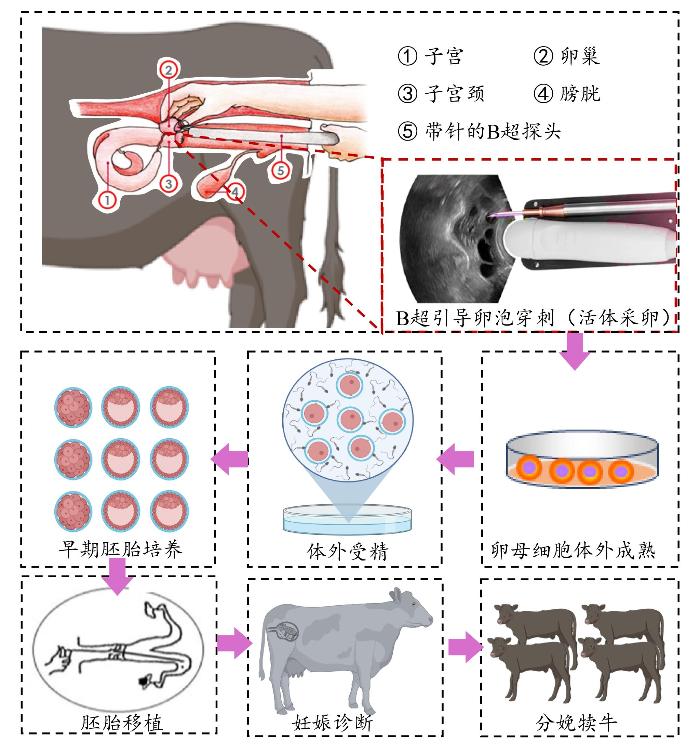
具体步骤如图1所示,第一步为供体牛OPU,需将供体牛保定后实施尾椎硬膜外麻醉,技术人员通过直肠触诊定位卵巢,把握定位后将采卵仪配备的阴道超声探头(5~7.5 MHz)置入阴道穹窿。在超声屏幕上清晰观察到卵泡后,在B超引导下将采卵针(17~19 G,长55~60 cm)刺入直径大于2 mm的卵泡内,调节负压泵在40 mmHg左右,负压抽吸卵泡液,从而回收卵丘-卵母细胞复合体(COCs)。第二步为IVM,将采集的卵泡液于实验室内倒入集卵漏斗或胚胎滤网,在体视显微镜下筛选出卵丘细胞包裹致密、胞质均匀的COCs。将筛选出的COCs置于成熟培养液(通常以TCM-199为基础,添加10%胎牛血清、FSH、LH及雌二醇等成分)中,于38.5 ℃、5% CO₂、饱和湿度的CO₂培养箱内培养22~24 h,完成减数分裂并达到成熟。第三步为IVF,选取优质种公牛冻精,解冻后经密度梯度离心等处理以分离活力良好的精子,再使用含肝素(20 μg/mL)等精子获能因子的受精液进行精子获能处理,随后将获能精子与成熟的卵母细胞共孵育18~22 h,完成体外受精。体外胚胎培养:受精卵在胚胎培养液(如CR1aa或SOF等)中继续发育,通常培养7 d后可发育至桑葚胚或囊胚阶段,随后进行胚胎移植或玻璃化冷冻保存。胚胎移植:在显微镜下根据囊胚扩张程度及内细胞团、滋养层细胞完整性等标准挑选发育状态良好的囊胚,移植至发情后第7天、黄体发育良好(经直肠触诊或B超确认黄体大小及质地)且具有功能性黄体一侧的子宫角大弯处,移植后约45 d通过直肠检查或B超进行妊娠诊断,以评估移植成功率。
1.3 宁夏OPU-IVP技术应用实践与效果分析
依托区域资源与科研力量,西北农林科技大学靳亚平教授领衔的奶牛种业创新团队在宁夏围绕OPU-IVP技术开展了系统性的应用实践,初步构建了从供体筛选到胚胎移植的完整技术链条。
1.3.1 供体筛选与胚胎生产
1.3.2 胚胎移植与妊娠管理
为承接体外胚胎的生产能力,笔者所在团队在区内3个规模化养殖场(存栏成年荷斯坦母牛分别为3000、6000和10000头)建立了受体牛群并开展胚胎移植工作,自2021年4月起,笔者所在团队持续在上述牧场开展胚胎移植生产实践推广;其中,2024年1月至2025年12月,累计为500余头荷斯坦受体牛移植体外胚胎,平均移植妊娠率稳定在45%~60%。移植后的妊娠管理严格规范,妊娠后期胚胎丢失率成功控制在3.5%以内,有效保障了胚胎移植的整体效率[31]。
1.3.3 实践效果与效率比较
近年来,宁夏地区已开展规模化OPU-IVP-ET工作。在技术持续应用的三年内,区域核心育种群规模扩大了约30%~50%。在宁夏回族自治区重点研发计划“揭榜挂帅”项目(2022年8月—2025年12月)的支持下,由宁夏回族自治区畜牧工作站发榜,山东奥克斯畜牧种业有限公司、西北农林科技大学靳亚平教授奶牛种业创新团队、宁夏大学及宁夏农垦贺兰山奶业有限公司等单位联合承担实施,重点围绕奶牛和肉牛OPU‑IVP‑ET技术开展攻关与推广应用[32]。项目实施前(2022年初),全区可供筛选组建核心群的成年母牛规模约为10.5万头;至2025年底,全区优质荷斯坦高产奶牛核心群已发展至超过15万头。西北农林科技大学奶牛种业创新团队于2022年底在国内率先突破养殖场内OPU-IVP工厂化胚胎生产技术体系,实现不影响正常繁育计划的活体采卵-体外生产胚胎批量繁育;同期成功培育出国内首批体细胞克隆奶牛(百吨超级奶牛克隆),并开展和牛OPU-IVP-ET技术攻关与实践推广,为种子母牛快速扩繁和核心群扩增提供了根本技术保障。
在政府、企业与高校科研院所等多方力量的协同攻关下,截至2025年底,全区已建成4个良种扩繁示范场、5个体外胚胎生产中心,年生产优质胚胎2.56万枚,鲜胚移植受胎率达47%,冻胚移植受胎率达37%。另外,由北京首农畜牧与海原县肉牛产业集团合作成立的海原县良种牛繁育中心,注册资金2500万元[32],2023年3月取得种畜禽经营许可证后正式投产,初始核心种牛存栏512头,其中种公牛65头、种子母牛447头,品种涵盖西门塔尔(美系、德系、澳系、法系等多个品系)、安格斯和荷斯坦等优良品种。在《2024中国肉用及乳肉兼用种公牛遗传评估概要》中,该中心有5头种公牛跻身全国百强,种公牛站排名全国第七、西北第一。在三年技术应用周期内,依托上述种牛群基础结合OPU-IVP技术的应用推广,核心育种群规模由512头扩展至665~768头,扩大了约30%~50%。这些结果表明,OPU-IVP技术能够在较短时间内显著提升优质种源供给能力,为区域肉牛遗传改良和基因组选择群体建设提供了重要的群体基础。
由表1可知,从经济与技术效率角度看,OPU-IVP模式同样展现出显著优势。与国内其他地区引种相比,本地实施OPU-IVP可将良种获取周期缩短6个月以上,同时降低生物安全风险和运输成本。在经济投入方面,人工授精技术按2次授精获得一头犊牛计算,综合成本(含药物)在200~400元/头;使用超数排卵人工授精胚胎移植生产每头犊牛的繁育成本约1.34万~1.74万元/头[33];使用OPU-IVP技术生产胚胎平均成本(包含药物、冻精、培养试剂和胚胎移植耗材,不包含人工成本)约为2500元(明显低于进口胚胎的10500元),胚胎移植按2枚胚胎获得一头犊牛计算,综合成本约8000元/头。从产出效率看,在相同周期内,OPU-IVP模式可获得的后代数量为传统自繁方式的3倍以上[34]。
表1 不同良种扩繁技术效率与成本比较Table 1 Comparison of different cattle breeding technologies |
| 技术手段 Technical means | 单头母牛年后代数offspring per year/头 | 扩繁速度 Propagation speed | 技术成本 Cost | 应用阶段 The current application phase |
|---|---|---|---|---|
| 自然交配Natural mating | ≈1 | 慢 | 低 | 普遍 |
| 人工授精Artificial insemination | ≈1 | 慢 | 低 | 普遍 |
| 超数排卵胚胎移植Superovulation and embryo transfer | 5~10 | 中 | 中 | 部分应用 |
| 活体采卵胚胎移植OPU-IVP-ET | 20~50 | 快 | 中高 | 快速发展 |
1.4 “肉奶融合”背景下的路径探索
在肉奶融合的生产体系下,当前主要形成了两种不同的技术路径:一是以人工授精为基础的肉牛与奶牛杂交生产模式,二是以OPU-IVP为核心的纯种肉牛胚胎生产与移植模式(图2)。
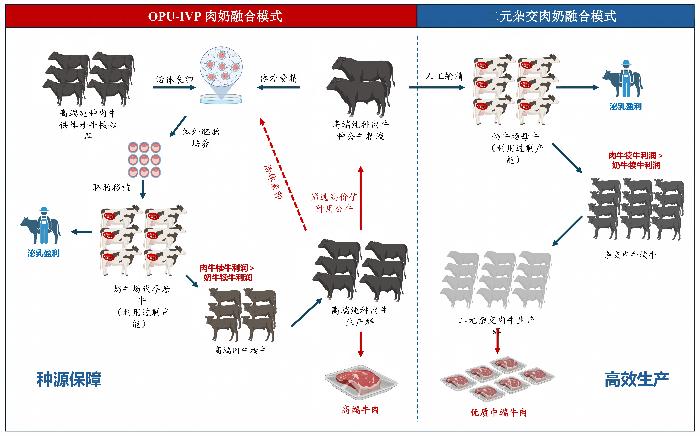


二元杂交肉奶融合生产模式是目前推广较为广泛的一种技术路径。该模式利用安格斯、西门塔尔等肉牛品种冻精与荷斯坦奶牛进行人工授精,生产杂交F1代肉牛用于育肥[35]。有研究表明,不同肉牛品种与荷斯坦牛杂交后代在生长性能和肉质特性方面存在差异。例如,安格斯×荷斯坦后代日增重较高、肉质稳定性好[36];德系西门塔尔×荷斯坦后代生长优势强、乳肉兼用潜力大[37];和牛×荷斯坦后代则能显著提高肌内脂肪含量,适用于高端市场[38]。该模式的优势在于技术门槛低、人工授精已在基层广泛应用,能够快速扩大优质肉牛生产规模。适用于奶牛养殖场,通过充分利用荷斯坦奶牛母本资源,生产高生长性能的杂交代肉牛用于育肥,在保持奶牛产奶产业链条不变的前提下挖掘肉牛增量效益,属于生产端的“效益变现”路径。
从产业发展角度看,这2种生产模式互为补充,杂交生产模式适合在大范围内推广,可快速扩大优质肉牛生产规模;而OPU-IVP技术则更适用于核心种群建设和高端种源扩繁[39]。在实际生产中,一些大型企业和育种机构已经开始采用“种源扩繁+商品生产”相结合的模式,即利用OPU-IVP技术快速扩繁优质种牛群体,同时在普通奶牛群体中推广肉牛杂交生产,实现高端种源培育与规模化肉牛生产的协同发展。
因此,在宁夏等肉牛主产区,依托区域内现有的奶牛资源基础,探索“OPU-IVP技术+肉奶融合生产”的综合应用模式,有望在提升肉牛良种扩繁效率的同时,进一步增强产业整体竞争力,并为形成具有区域特色的良种快速扩繁模式奠定基础。
2 国内OPU-IVP技术应用模式比较
2.1 企业主导型
一些商业化的育种公司,如青岛隆铭牛业有限公司(以下简称“青岛隆铭牛业”)较早在高端肉牛种源扩繁中引入了OPU-IVP技术。这些企业通常以明确的商业化育种目标为导向,围绕高价值品种构建核心母牛群,集成“基因组选择与OPU-IVP-ET”等技术用于优质种源的规模化扩繁。
2.2 校企合作型
由科研单位提供技术核心与质量控制,企业提供生产场景与资源条件;技术推广与地方遗传改良需求高度契合,有利于服务区域性核心育种群建设,示范与培训功能突出,对周边地区具有较强带动作用。校企合作型模式的核心优势在于“科研下沉+现场化应用”所带来的技术转化效率提升。将实验室搬到牧场,不仅缩短了样品运输距离,更重要的是缩短了“技术研发-问题反馈-方案优化”的迭代周期。科研人员能够实时观察采卵效果、胚胎发育情况和移植妊娠结果,快速调整技术参数。而企业技术人员则在实践中逐步掌握核心技术,促进技术推广与地区发展。校企模式通过现场化应用,降低了技术转化的“最后一公里”成本,使前沿生物技术能够在生产一线真正落地。
2.3 产学研平台型
2.4 不同模式比较与启示
综合上述案例可以看出,我国OPU-IVP技术在肉牛遗传改良中的应用大体形成了3种实践路径(表2),各自蕴含着独特的关键成功要素:①企业主导的商业化扩繁模式,其成功关键在于“高价值品种+高资金投入+闭环产业链”的商业闭环,适用于高端育种企业;②校企合作的区域示范推广模式,其核心优势在于“科研下沉+现场化应用”所带来的技术转化效率提升,适用于技术引进初期的区域推广;③产学研联合的平台化运行模式,其根本价值在于“长期稳定合作+标准化数据积累”所催生的技术成熟度提升,适用于技术的体系化、规模化应用。
表2 我国公开报道的OPU-IVP技术应用典型案例对照表Table 2 Comparative table of representative cases of OPU-IVP technology application in China's publicly reported literature |
| 案例类型 Case type | 代表主体 Representative body | 应用对象 Applicable objects | 组织模式 Organizational model | 技术目标 Technical objectives | 启示 Revelation |
|---|---|---|---|---|---|
| 企业主导型Enterprise-led | 青岛隆铭牛业 | 高端肉牛 | 企业+科研合作 | 商业化种源扩繁 | 技术成熟度高,但投入要求高 |
| 校企合作型School-enterprise cooperative model | 西北农林科技大学×兴源达农牧有限公司 | 奶牛+肉牛 | 高校+企业+地方 | 区域良种快速扩繁 | 与宁夏实践高度契合 |
| 平台联合型 Platform-integrated type | 山东农科院×种业企业 | 奶牛 | 产学研联合 | 体系化、规模化运行 | 强调标准化与长期机制 |
相较而言,宁夏正在探索形成的OPU-IVP应用路径,更接近于“校企合作+区域组织实施”的综合模式。宁夏模式主要吸收了校企合作型模式的“现场化应用”理念,将技术真正落地到生产一线。同时,宁夏地区还借鉴了平台联合型模式的系统思维,通过区域统筹组织实现技术推广的规模效应。通过与地方遗传改良需求深度契合,能够紧密对接国家肉牛遗传改良计划目标,在资源条件相对有限但育种需求迫切的主产区具有独特的推广价值。
综上所述,不同地区在OPU-IVP技术应用过程中形成了多种组织模式,但其核心目标均在于通过技术集成提升优质种源扩繁效率。相比之下,宁夏探索形成的“科研机构技术支撑+企业牧场生产应用+区域统筹组织实施”的综合模式,在技术推广可行性和区域适应性方面具有明显优势,为OPU-IVP技术在我国肉牛主产区的应用提供了具有参考价值的实践路径。
3 “宁夏模式”的比较优势
宁夏模式是以科研机构为技术源头、企业牧场为生产主体、区域统筹组织为协调中枢的“三位一体”良种快速扩繁路径。其核心特征可概括为“高校科研单位技术下沉、奶牛群体作为优质肉牛受体牛扩容、政府统筹推广”。宁夏模式成功将区域奶牛存量优势转化为肉牛扩繁的受体资源,有效破解了“肉牛受体不足”的全国性难题。同时,该模式还通过区域统筹组织使技术推广从企业点状示范升级为县域乃至省域覆盖,显著降低了单头扩繁成本。重要的是,科研团队的现场驻扎能够根据本地品种特性(如安格斯牛的囊胚率)快速优化技术参数,避免“水土不服”。
基于上述优势,宁夏模式形成了一些可供其他肉牛主产区复制的关键要点:一是借“奶”生“肉”,充分利用现有奶牛群体作为受体平台,无须另行建设受体牛场;二是“政府搭台、科研唱戏、企业运作”,即由省级畜牧技术推广机构牵头制定标准,引入高校技术团队现场支撑,委托有实力的企业承担胚胎生产和移植任务;三是构建分层利益联结机制,针对核心育种、技术转化、基层推广等不同环节,分别采用股权合作、技术服务收费、政府采购加农户受益等模式,确保各主体均有可持续收益;四是推行“良补冻精+见犊补母+胚胎移植奖补+风险补偿基金”四位一体的政策组合包,降低前期应用成本;五是坚持数据驱动选育,将OPU-IVP胚胎生产数据、后裔测定数据与基因组选择平台对接,实现“生产-测定-评估-再选育”的闭环。这些要素共同构成了宁夏模式的核心逻辑,为其他地区提供了可操作、可落地的实践范本。
综上所述,宁夏模式并非对既有路径的简单叠加,而是在整合了企业主导型的高效执行力、校企合作型的技术落地能力、平台联合等经验的基础上,同时结合宁夏地区“肉奶融合”的独特资源条件,通过区域统筹形成的一种“资源整合型”或“区域集成型”的良种快速扩繁路径。以相对可控的成本,在较短时间内显著提升了区域优质种源的自主供给能力和核心育种群规模,为技术、资源与产业需求的有效结合提供了一个可借鉴的实践范本。
4 OPU-IVP技术应用瓶颈分析
从技术角度看,OPU-IVP涉及多个环节,各环节之间的一致性直接影响最终效果。OPU-IVP是一项包含多个环节的技术集成,每个环节的标准化程度都直接影响最终效果[7]。在OPU环节,采卵效率受供体牛个体差异(年龄、品种、卵泡发育状态、对激素的反应性)影响显著,导致不同供体、不同批次的获卵数和可用卵母细胞数波动较大[31]。同时,采卵操作高度依赖技术人员的经验,操作手法、B超引导的精准度、负压大小等因素都会影响卵母细胞的质量和数量,使得不同操作人员之间的效率存在明显差异。在体外培养环节,体外成熟、受精和培养所需的培养基配方、气相条件(CO₂、O₂浓度)、培养温度等参数,目前在国内尚未形成统一标准。不同实验室、不同商业公司采用的培养体系存在差异,导致胚胎发育率(囊胚率)参差不齐,从30%到50%[54],影响了技术的稳定性和可预期性。在胚胎质量评价环节,目前主要依赖形态学评价(如发育阶段、细胞均匀度、碎片率等),受人为判断影响较大,尽管已有分子层面的评价方法在研究中开展,但在生产中应用还不普遍,这些因素共同影响了技术效果的稳定性。
结合宁夏实际情况,该问题表现更为具体。目前宁夏正处于由示范应用向规范化运行过渡阶段。一方面,区内OPU操作主要依赖高校技术团队或少数技术骨干,基层技术人员参与程度有限,不同操作主体之间在采卵效率和卵母细胞质量上仍存在差异;另一方面,本地实验室建设水平不一,部分关键环节仍需依托外部实验平台完成,现场化和标准化程度有待提升。在体外培养方面,不同实施主体在培养体系选择上存在差异,尚未形成统一的区域技术规范,导致胚胎发育率稳定性不足。此外,胚胎质量评价多依赖经验判断,缺乏统一的操作标准和质量控制体系,在一定程度上制约了技术的可复制性。
更为重要的是,成本控制瓶颈限制了技术的规模化推广[55]。从成本构成来看,直接成本主要包括耗材(采卵针、过滤器、培养皿、移液管等)、试剂(培养基、激素、血清、冷冻保护剂等)、设备(B超仪、显微操作台、CO₂培养箱、体视显微镜等)的购置与折旧,以及人员工资、实验室运行维护费用。其中,耗材和试剂属于高频消耗品,是日常运行的主要开支;设备则属于前期一次性投入。在单枚胚胎的生产成本中,耗材和试剂费用通常占比最高,可达40%~50%;人员工资和技术服务费约占30%~40%;设备折旧和管理费用约占20%。这意味着,即使设备投入到位,日常运行的“流水性支出”依然可观。当前成本控制的核心在于提高单位供体的可用胚胎产出率。具体而言,提高卵母细胞的体外成熟率、受精率和囊胚发育率,可以在不增加供体数量和采卵次数的前提下,增加单批次生产的可用胚胎数量,从而摊薄单枚胚胎的成本。此外,简化培养流程(如探索一步式培养液)、优化运输条件(如建立现场化实验室缩短运输距离)、国产替代耗材的开发应用等,也都是降低成本的重要方向。在宁夏本地,这一问题还体现在产业配套能力不足上。目前部分关键试剂和耗材仍依赖外购,本地配套水平有限,增加了运行成本;同时,由于专业技术人员相对不足,技术服务费用占比偏高。叠加应用规模尚未完全形成,单批次生产量有限,规模效应尚未显现,使得整体成本压力更加突出。
在产业应用层面,OPU-IVP的推广还涉及组织和管理问题。一方面,技术体系与现有产业体系之间仍存在一定衔接障碍。在“肉奶融合”模式下,供体方与受体牧场之间的利益分配与责任划分尚不清晰。例如,胚胎移植后犊牛的归属、受体牛妊娠管理成本的承担以及相关生产风险的分担等,若缺乏明确约定,容易影响合作的稳定性。同时,胚胎移植成功率受多种因素影响,存在一定不确定性,在实际操作中相关风险多由受体牧场承担,一定程度上降低了其参与积极性。此外,供体采卵计划与受体牛发情周期需要较高程度的同步,对牧场繁殖管理水平提出了更高要求;受体牛筛选及妊娠管理流程的增加,也提高了运营复杂度。结合宁夏地区实际应用情况,虽然“肉奶融合”具备一定基础,但多以项目化合作为主,缺乏长期稳定的利益联结机制。供体企业与奶牛牧场之间在收益分配、成本承担及风险分担方面尚未形成统一模式,实际操作中多依赖个案协商,增加了不确定性。同时,部分奶牛牧场在精细化繁殖管理方面仍有提升空间,进一步增加了技术实施难度。总体来看,上述因素共同制约了OPU-IVP技术在宁夏由示范应用向规模化推广的转变。
5 展望
随着肉牛遗传改良工作的深入推进,OPU-IVP技术在提高母本扩繁效率方面的作用将进一步显现。但其发展重点将不再局限于单一技术优化,而是与区域现有育种体系协同推进。结合宁夏地区奶牛肉牛产业基础,将OPU-IVP与基因组选择相结合,是更为可行的技术路径。在供体选择阶段引入基因组育种值评价,优先利用遗传潜力高的个体进行采卵,可从源头提升扩繁后代质量;同时,对OPU-IVP后代开展早期基因组检测,有助于缩短选育周期,提高育种效率。
在组织方式上,可依托现有良种繁育中心和生产性能测定数据,推动区域内种牛场与规模牧场之间的数据共享,逐步形成稳定的联合育种机制。OPU-IVP主要服务于核心群体的快速扩繁,而遗传评估体系负责持续筛选与优化种质,两者形成相对清晰的分工关系。在生产应用层面,OPU-IVP更适用于高价值种源扩繁,普通养殖场仍以杂交生产为主。通过“核心群扩繁+商品群生产”的分层模式,有助于在控制成本的同时兼顾遗传改良与产业效益。此外,针对宁夏地方种质资源,也可探索利用OPU-IVP开展优良个体扩繁与保种,并结合基因组手段进行定向选育,提升地方品种利用水平。
在此基础上,技术推广还需相应的政策与机制配套。一是完善技术培训体系,依托区内高校和科研单位,建立分层分类的技术培训与现场指导机制,提高基层技术人员和牧场操作水平;二是优化财政支持方式,在现有良种补贴基础上,探索对OPU-IVP胚胎生产、移植及关键耗材的阶段性补贴,降低应用初期成本;三是强化产学研协同,建立长期稳定的合作机制,对参与联合攻关和技术转化的主体给予适当激励,促进技术持续优化与落地;四是完善利益共享与风险分担机制,通过合同规范或地方性指导意见,明确供体方与受体方在成本、收益及风险方面的责任划分,减少合作不确定性。
综上,OPU-IVP技术只有嵌入区域育种体系,并与基因组选择等技术协同应用,同时配套相应的组织与政策支持,才能稳定发挥作用。围绕宁夏肉牛种源扩繁与自主供给目标,逐步完善数据、技术与制度体系,有望推动该技术由示范应用走向常态化生产。