1 DLK1-DIO3印记簇研究历史
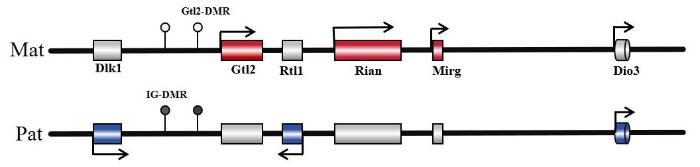
2 DLK1-DIO3印记簇内印记基因的功能
2.1 DLK1
2.2 RTL1
2.3 GTL2
2.4 DIO3
3 DLK1-DIO3印记簇的印记调控模式
3.1 IG-DMR区的甲基化调控
3.2 DLK1-DIO3印记簇对Callipyge表型的调控作用
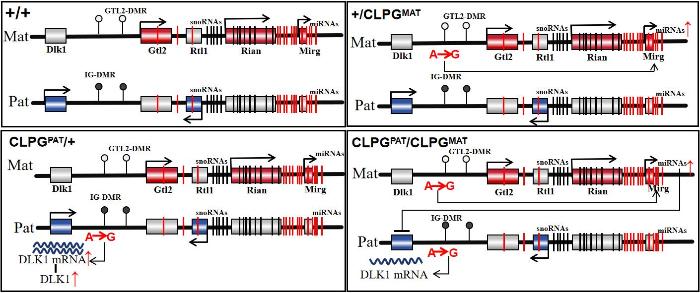


图2 Callipyge表型调控模式图 Fig. 2 Regulatory model of the Callipyge phenotype |


The Chinese Livestock and Poultry Breeding >
Research progress on the DLK1–DIO3 imprinted cluster in livestock embryonic development
Received date: 2026-01-05
Online published: 2026-09-10
Imprinted genes are regulated through epigenetic mechanisms and are expressed in a parent-of-origin-specific manner. These genes are often clustered together and serve as crucial regulators in normal embryonic development and individual health. The DLK1-DIO3 imprinted cluster is a key regulatory region influencing livestock embryonic development and placental formation. The imprinting status of this cluster is primarily determined by the parent-of-origin-specific methylation of the core imprinting control region, IG-DMR(Imprinting Gene Differentially Methylated Region), which governs the overall parent-specific expression pattern of the cluster. GTL2-DMR(GTL2-Differentially Methylated Region), as a secondary DMR, maintains the stable expression of the maternal transcripts. This review summarizes the composition, imprinting regulation, and functional roles of this cluster, with a particular focus on the regulatory functions of the paternal genes DLK1, RTL1, DIO3, and the maternal gene GTL2 in placental angiogenesis, muscle growth, neural differentiation, and energy metabolism. The case of the Callipyge (CLPG) sheep, exhibiting a polar overdominant inheritance pattern, highlights the potential of manipulating this gene cluster to improve meat production traits and reproductive performance in livestock, so as to provide theoretical reference for improving the production performance and reproductive efficiency of livestock.
Key words: Genomic imprinting; DLK1-DIO3; Livestock; Embryonic development
Sihan Ju , Liang Zhu , Wenqian Zhao , Zhonghua Liu , Xiaogang Weng . Research progress on the DLK1–DIO3 imprinted cluster in livestock embryonic development[J]. The Chinese Livestock and Poultry Breeding, 2026 , 22(9) : 95 -102 . DOI: 10.19543/j.cnki.1673-4556.20260803.001
图2 Callipyge表型调控模式图 Fig. 2 Regulatory model of the Callipyge phenotype |
| [1] |
|
| [2] |
|
| [3] |
|
| [4] |
|
| [5] |
|
| [6] |
|
| [7] |
|
| [8] |
|
| [9] |
|
| [10] |
|
| [11] |
|
| [12] |
|
| [13] |
|
| [14] |
ONO R,
|
| [15] |
|
| [16] |
|
| [17] |
|
| [18] |
|
| [19] |
|
| [20] |
|
| [21] |
|
| [22] |
|
| [23] |
|
| [24] |
|
| [25] |
|
| [26] |
|
| [27] |
|
| [28] |
|
| [29] |
|
| [30] |
田佺, 赵祎, 王卓, 等. 延边黄牛lncRNA MEG3基因多态性及其与生长性状的关联分析[J]. 中国畜牧兽医, 2021, 48(12): 4567-4574.
|
| [31] |
|
| [32] |
|
| [33] |
|
| [34] |
|
| [35] |
|
| [36] |
|
| [37] |
|
| [38] |
|
| [39] |
|
| [40] |
|
| [41] |
|
| [42] |
王会, 柴志欣, 朱江江, 等. 牦牛Linc24063的克隆鉴定及其与miRNAs表达水平的相关性分析[J]. 中国农业科学, 2019, 52(14): 2538-2547.
|
| [43] |
|
| [44] |
|
| [45] |
|
| [46] |
|
| [47] |
|
| [48] |
|
| [49] |
|
| [50] |
|
| [51] |
|
| [52] |
|
| [53] |
杨文志, 张明月, 王冠楠, 等. 2个印记的基因间lncRNAs位于牛Dlk1-Dio3印记区域[J]. 畜牧兽医学报, 2016, 47(9): 1848-1852.
|
| [54] |
杨莎, 郝海生, 杜卫华, 等. CRISPR/dCas9技术在基因表达调控中的研究进展[J]. 中国畜牧兽医, 2022, 49(1): 53-59.
|
| [55] |
王丽娟. 正反交猪骨骼肌生长发育相关基因表达及表观遗传修饰的发育性变化研究[D]. 南京: 南京农业大学, 2011.
WANG, L J. Developmental changes of gene expression and epigenetic modifications related to skeletal muscle growth in reciprocal-cross pigs [D]. Nanjing: Nanjing Agricultural University, 2011.
|
| [56] |
张宸艺博, 余彤, 任斌斌, 等. 动物早期胚胎发育中表观重编程的机制[J]. 畜牧兽医学报, 2023, 54(12): 4898-4909.
|
/
| 〈 |
|
〉 |