中国畜禽种业 ›› 2026, Vol. 22 ›› Issue (7): 38-44.doi: 10.19543/j.cnki.1673-4556.20260602.006cstr: 32418.14.j.cnki.1673-4556.20260602.006

• 生物技术 • 上一篇    下一篇

基于SNP芯片解析永胜红骨绵羊的群体遗传结构

李锦南1(), 王金明2(), 王识之1, 朱兰1, 杨冬梅2, 刘彩娟2, 杨开梅2, 陈浩林3, 邵庆勇1()   

  1. 1. 云南省畜牧兽医科学院,云南 昆明 650224
    2. 永胜县畜牧站,云南 丽江 674200
    3. 贵州省畜牧兽医研究所,贵州 贵阳 550050
  • 收稿日期:2025-11-17 出版日期:2026-07-26 发布日期:2026-07-18
  • 通讯作者: 邵庆勇 E-mail:jinnan_li@outlook.com;shaoqingyong@163.com
  • 作者简介:
    李锦南(1997—),男,云南昆明人,助理研究员,主要从事动物遗传育种与遗传资源评价鉴定工作,E-mail:#共同第一作者
    李锦南(1997—),男,云南昆明人,助理研究员,主要从事动物遗传育种与遗传资源评价鉴定工作,E-mail:#共同第一作者
    王金明(1975—),男,云南永胜人,高级兽医师,主要从事牛羊科学养殖及畜禽粪污资源化利用工作,E-mail:
  • 基金资助:
    云南省科技人才与平台计划(202505AF350008); 永胜红骨绵羊资源鉴定、评价与利用(2023HT015); 国家肉羊产业技术体系建设项目(CARS-38-36)

Analysis of population genetic structure of Yongsheng Red-bone sheep based on SNP chip

Jinnan Li1(), Jinming Wang2(), Shizhi Wang1, Lan Zhu1, Dongmei Yang2, Caijuan Liu2, Kaimei Yang2, Haolin Chen3, Qingyong Shao1()   

  1. 1. Yunnan Animal Science and Veterinary Institute, Kunming, 650224, Yunnan
    2. Yongsheng Animal Husbandry Station, Lijiang, 674200, Yunnan
    3. Guizhou Animal Science and Veteirnary Institute, Guiyang, 550050, Yunnan
  • Received:2025-11-17 Online:2026-07-26 Published:2026-07-18
  • Contact: Qingyong Shao E-mail:jinnan_li@outlook.com;shaoqingyong@163.com

摘要:

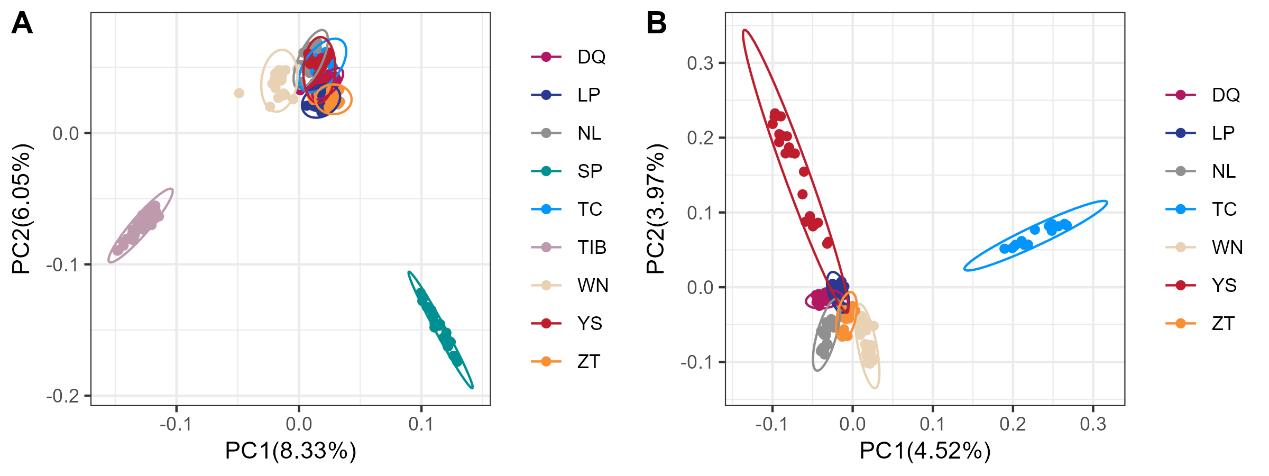
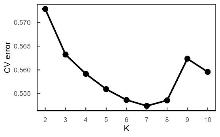
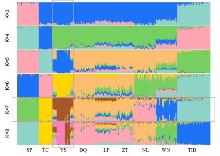
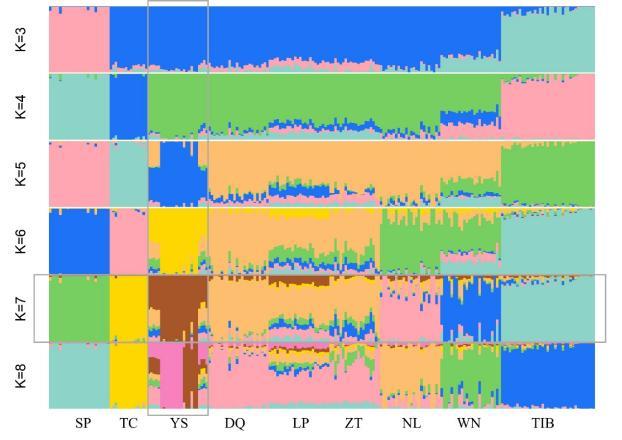
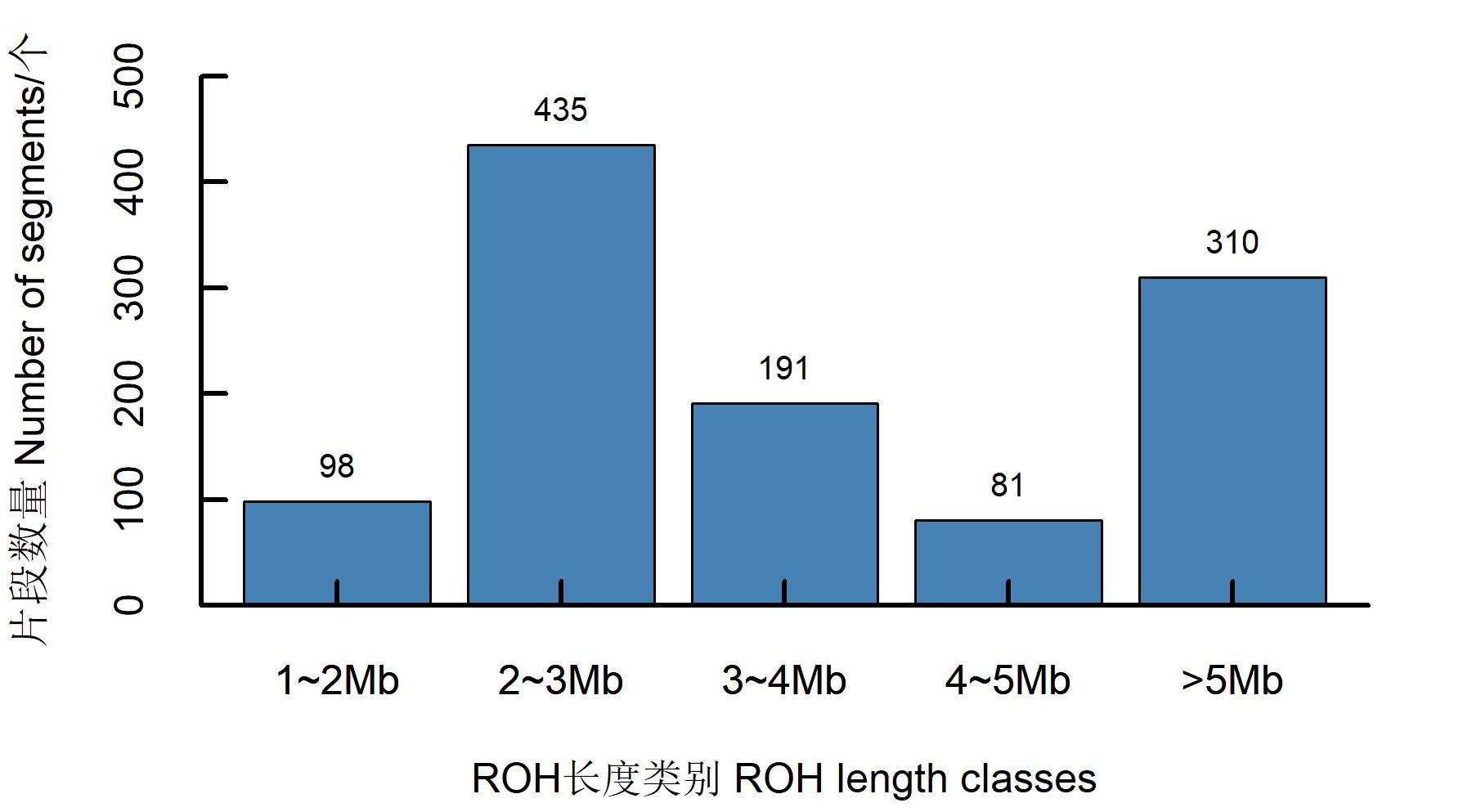
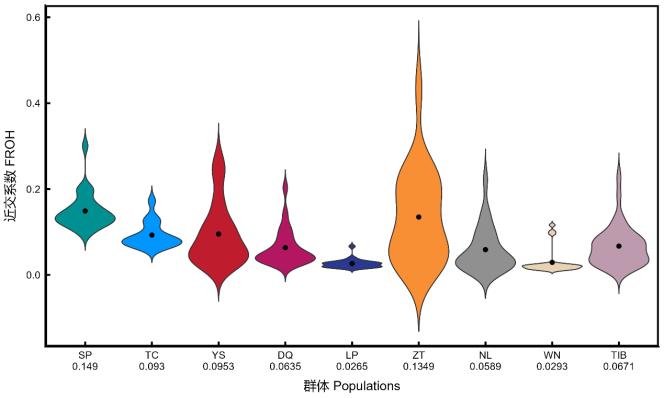
目的 为探究永胜红骨绵羊的遗传背景,揭示其与云南及周边绵羊资源的关联性与独特性,为云南地方绵羊资源的鉴定及保护提供科学依据。 方法 本试验使用OvineSNP50芯片对24只永胜红骨绵羊进行基因分型,并以6个云南地方绵羊品种、西藏羊和威宁绵羊作参照,通过系统发育树构建、主成分分析、血统分析、连续纯合片段(Runs of homozygosity, ROH)检测以及遗传分化指数计算等方法系统解析永胜红骨绵羊的群体遗传结构。 结果 使用Illumina OvineSNP50芯片进行基因分型,9个绵羊群体共216个个体经质控后保留46129个高质量SNP用于后续分析。系统发育树结果显示,永胜红骨绵羊在树形上独立于其他绵羊群体。主成分分析结果显示,永胜红骨绵羊能与迪庆绵羊、兰坪乌骨绵羊、宁蒗黑绵羊、威宁绵羊区分开,分化程度相对较高。ADMIXTURE软件分析结果显示,K=7是9个绵羊群体的最佳模拟祖先血统预测数量,永胜红骨绵羊有独特的祖先血统结构,其中部分个体血统存在混杂。ROH统计结果显示,该群体ROH长度主要集中在2~3 Mb,群体近交系数(FROH)为0.0953。永胜红骨绵羊与兰坪乌骨绵羊的遗传分化指数(Fst)最小(0.0459),与其他绵羊群体之间的FST均大于0.06。 结论 综上,永胜红骨绵羊具有独特的群体遗传结构,与兰坪乌骨绵羊可能存在历史基因交流。

关键词: 永胜红骨绵羊, 遗传资源, 群体遗传结构, 种质资源鉴定

Abstract:

Objective This study aims to explore the genetic background of Yongsheng Red-bone sheep and to reveal their genetic relationship and specificality with respect to sheep resources in Yunnan and surrounding areas and provides a scientific basis for the identification and conservation of local sheep genetic resources in Yunnan. Method A total of 24 Yongsheng Red-bone sheep were genotyped using the OvineSNP50 BeadChip. Six local Yunnan sheep breeds, Tibetan sheep, and Weining sheep were used for references. The population genetic structure of Yongsheng Red-bone sheep was systematically analyzed through phylogenetic tree construction, principal component analysis, ancestry analysis, runs of homozygosity (ROH) detection, and calculation of genetic differentiation index. Result Genotyping was performed using the Illumina Ovine SNP50 chip. A total of 46,129 high-quality SNPs were retained for subsequent analysis after quality control of 216 individuals in 9 sheep populations. The phylogenetic tree showed that Yongsheng Red-bone sheep formed a distinct branch independent of other sheep populations. The results of principal component analysis showed that Yongsheng Rred-bone sheep could be distinguished from Diqing sheep, Lanping Black-bone sheep, Ninglang sheep and Weining sheep, and the degree of differentiation was relatively high. ADMIXTURE analysis revealed that K=7 was the optimal number of ancestral populations for the nine sheep populations, and Yongsheng Red-bone sheep exhibited a unique ancestral composition, with some individuals showing admixture. ROH analysis indicated that the ROH lengths in this population were mainly concentrated in the range of 2~3 Mb, with an inbreeding coefficient(FROH) of 0.0953. The smallest genetic differentiation index(Fst) occurred between Yongsheng Red-boned sheep and Lanping Black-bone sheep(0.0459), while those with other populations were all greater than 0.06. Conclusion In summary, Yongsheng Red-bone sheep possess a unique population genetic structure and may have experienced historical gene flow with Lanping Black-bone sheep.

Key words: Yongsheng Red-bone sheep, Genetic resource, Population genetic structure, Genetic resource identification

中图分类号: 

  • S826

表1

各绵羊群体样本信息"

群体Population name 缩写Abbreviation 采样地点Sampling location 采样时间Sampling time 样本量Sample size/个
永胜红骨绵羊Yongsheng Red-bone sheep YS 云南省丽江市永胜县 2023.10 24
迪庆绵羊Diqing sheep DQ 云南省迪庆州香格里拉市 2023.10 24
兰坪乌骨绵羊Lanping Black-bone sheep LP 云南省怒江州兰坪县 2023.08 24
宁蒗黑绵羊Ninglang Black sheep NL 云南省丽江市宁蒗县 2023.08 24
石屏青绵羊Shiping Cyan sheep SP 云南省红河州石屏县 2023.09 24
腾冲绵羊Tengchong sheep TC 云南省保山市腾冲市 2023.06 15
西藏羊Tibetan sheep TIB 西藏自治区昌都市 - 37
威宁绵羊Weining sheep WN 贵州省毕节市威宁县 2024.8 24
昭通绵羊Zhaotong sheep ZT 云南省昭通市昭阳区 2023.10 20

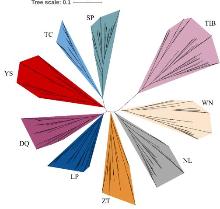
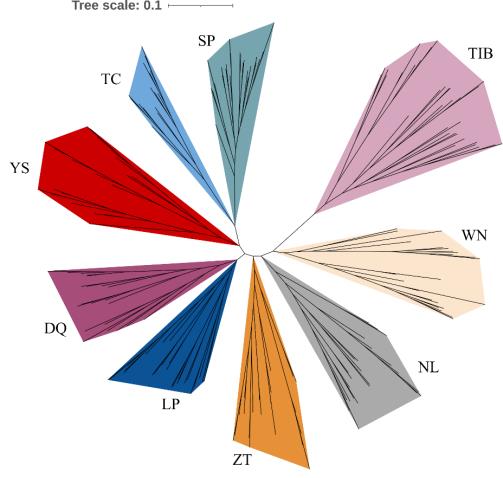
图1

各群体系统发育树"

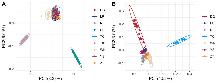
图2

主成分分析"

图3

不同K值的交叉验证误差"

图4

9个绵羊群体祖先血统构成"

图5

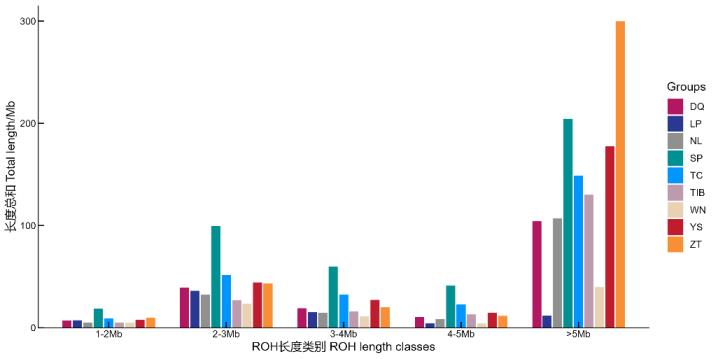
9个绵羊群体在不同ROH长度类别中的平均总和"

图6

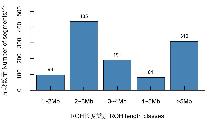
永胜红骨绵羊不同ROH长度类别中的数量分布情况"

图7

9个绵羊群体FROH分布情况 注:图中黑色圆形为平均数所在位置。"

表2

9个绵羊群体间遗传分化指数"

群体

Populations

石屏青绵羊

SP

腾冲绵羊

TC

永胜红骨绵羊

YS

迪庆绵羊

DQ

兰坪乌骨绵羊

LP

昭通绵羊

ZT

宁蒗黑绵羊

NL

威宁绵羊

WN

西藏绵羊

TIB

石屏青绵羊SP
腾冲绵羊TC 0.1578
永胜红骨绵羊YS 0.1203 0.1089
迪庆绵羊DQ 0.1102 0.1041 0.0601
兰坪乌骨绵羊LP 0.0940 0.0889 0.0459 0.0327
昭通绵羊ZT 0.1046 0.0981 0.0627 0.0475 0.0345
宁蒗黑绵羊NL 0.1188 0.1040 0.0642 0.0554 0.0426 0.0546
威宁绵羊WN 0.1132 0.0900 0.0611 0.0555 0.0431 0.0490 0.0542
西藏绵羊TIB 0.1399 0.1181 0.0869 0.0815 0.0689 0.0829 0.0814 0.0673
[1]
胡万龙. 红骨绵羊遗传资源评价[D]. 昆明: 云南农业大学, 2016.
HU W L. Evaluation of germplasm in the red bone sheep[D]. Kunming: Yunnan Agricultural University, 2016.
[2]
杨明, 马琳, 王宣懿, 等. 云南红骨绵羊屠宰性能及相关性状分析[J]. 中国草食动物科学, 2021, 41(5): 31-36.
YANG M, MA L, WANG X Y, et al. Analysis on slaughtering and relative trait of Yunnan red bone sheep[J]. China Herbivore Science, 2021, 41(5): 31-36.
[3]
HAN D P, ZHANG Y Y, DENG W D, et al. FRRS1L variants and ferriheme overload drive hyperpigmentation and systemic Iron overload in Lanping black bone sheep[J]. Cell & Bioscience, 2025, 15(1): 87.
[4]
DORSHORST B, OKIMOTO R, ASHWELL C. Genomic regions associated with dermal hyperpigmentation, polydactyly and other morphological traits in the Silkie chicken[J]. The Journal of Heredity, 2010, 101(3): 339-350.
[5]
樊月圆, 余淑青, 曹振辉, 等. 云南红骨圭山山羊微卫星 DNA位点遗传多样性分析[J]. 云南农业大学学报(自然科学版), 2013(3): 329-335.
FAN Y Y, YU S Q, CAO Z H, et al. Microsatellite analysis of genetic diversity of red-bone Guishan goats and common Guishan goats[J]. Journal of Yunnan Agricultural University (Natural Science), 2013(3): 329-335.
[6]
VIJH R K, SHARMA U, ARORA R, et al. Development and validation of the Axiom-MaruPri SNP chip for genetic analyses of domesticated old world camelids[J]. Gene, 2024, 921: 148541.
[7]
LI C L, TONG X L, GAO R, et al. Silk_40K SNP array facilitates the genomic prediction of complex traits in silkworm (Bombyx mori)[J]. Journal of Advanced Research, 2025:S2090-1232(25)00916-6
[8]
MALLORIE T L, JULIEN P, WILLIAM P, et al. Validation of a 60K SNP chip for caribou (Rangifer tarandus) for use in wildlife forensics, conservation, and management[J]. Forensic Science International: Animals and Environments, 2024, 6: 100093.
[9]
KARABAŞ M, YıLMAZ O. Identification of selection signatures and genetic diversity in the sheep[J]. Tropical Animal Health and Production, 2025, 57(2): 68.
[10]
LI X P, ZHU L J, ZHANG C L, et al. Genetic structure and selective sweeps in Kirghiz sheep using SNP50K bead chip[J]. Frontiers in Genetics, 2024, 15: 1432105.
[11]
YANG R Z, HAN Z P, ZHOU W, et al. Population structure and selective signature of Kirghiz sheep by Illumina Ovine SNP50 BeadChip[J]. PeerJ, 2024, 12: e17980.
[12]
CHANG C C, CHOW C C, TELLIER L C, et al. Second-generation PLINK: rising to the challenge of larger and richer datasets[J]. GigaScience, 2015, 4: 7.
[13]
LEE T H, GUO H, WANG X Y, et al. SNPhylo: a pipeline to construct a phylogenetic tree from huge SNP data[J]. BMC Genomics, 2014, 15(1): 162.
[14]
LETUNIC I, BORK P. Interactive Tree of Life (iTOL) v6: recent updates to the phylogenetic tree display and annotation tool[J]. Nucleic Acids Research, 2024, 52(W1): W78-W82.
[15]
ALEXANDER D H, NOVEMBRE J, LANGE K. Fast model-based estimation of ancestry in unrelated individuals[J]. Genome Research, 2009, 19(9): 1655-1664.
[16]
DANECEK P, AUTON A, ABECASIS G, et al. The variant call format and VCFtools[C]. //Bioinformatics. ACM, 2011: 2156-2158.
[17]
阿旺措吉, 仁青措姆, 黄舒泓, 等. 基于重测序数据的昌都黑山羊遗传多样性及群体结构分析[J]. 家畜生态学报, 2022, 43(10): 30-35.
A W, RENQINGCUOMU, HUANG S H, et al. Genetic diversity and population structure analysis of Changdu black sheep based on resequencing data[J]. Journal of Domestic Animal Ecology, 2022, 43(10): 30-35.
[18]
周隽, 覃星文, 吴细波, 等. 基于SNP芯片对陆川猪进行遗传多样性与遗传结构分析的研究[J]. 中国畜牧杂志, 2023, 59(8): 257-263.
ZHOU J, QIN X W, WU X B, et al. Study on genetic diversity and genetic structure analysis of Luchuan pig based on SNP chip[J]. Chinese Journal of Animal Science, 2023, 59(8): 257-263.
[19]
YANG H L, DONG L, WANG H, et al. A simple way to visualize detailed phylogenetic tree of huge genome-wide SNP data constructed by SNPhylo[J]. Journal of Integrative Agriculture, 2018, 17(9): 1972-1978.
[20]
梁家充, 朱兰, 孙利民, 等. 云南地方绵羊品种遗传多样性分子评价[J]. 四川农业大学学报, 2018, 36(6): 822-830.
LIANG J C, ZHU L, SUN L M, et al. Molecular evaluation of genetic diversity of native sheep breeds in Yunnan Province[J]. Journal of Sichuan Agricultural University, 2018, 36(6): 822-830.
[21]
陈红艳, 马月辉, 叶绍辉. 云南5个地方绵羊品种遗传多样性研究[J]. 中国畜牧兽医, 2013, 40(12): 125-131.
CHEN H Y, MA Y H, YE S H. Study on genetic diversity of five local sheep breeds in Yunnan[J]. China Animal Husbandry & Veterinary Medicine, 2013, 40(12): 125-131.
[1] 王莎莎, 代永联, 黄晓, 吕良鹏, 张桐, 程明, 娄兰强. 胶河黑山羊遗传资源保护与开发利用现状研究[J]. 中国畜禽种业, 2026, 22(7): 77-82.
[2] 任端阳, 李文霞, 王馨培, 王曦. 基于全基因组SNP位点的晋南牛群体遗传结构分析与分子选配[J]. 中国畜禽种业, 2026, 22(6): 72-80.
[3] 陈博. 汉中绵羊品种资源的保护及开发利用[J]. 中国畜禽种业, 2023, 19(8): 67-73.
[4] 于桂阳, 蒋玉章, 曾斌, 何师凤. 湖南道州灰鹅遗传资源调查报告[J]. 中国畜禽种业, 2023, 19(8): 74-78.
[5] 张翔飞, 官久强, 赵洪文, 毛进彬, 安添午, 马宗亮, 柏琴, 罗晓林. 四川新牦牛遗传资源的挖掘[J]. 中国畜禽种业, 2023, 19(7): 90-96.
[6] 巴桑旺堆, 平措占堆, 鲜莉莉, 洛桑顿珠, 王登云, 俄广鑫, 张强. 查吾拉牦牛遗传资源概况与保护利用现状[J]. 中国畜禽种业, 2023, 19(6): 4-9.
[7] 王武生, 张金川, 江晓军, 马瑞军, 贾社强, 刘飞, 封赟, 马伟东, 李聪, 党瑞华. 关中驴种质资源保护及存在问题探析[J]. 中国畜禽种业, 2023, 19(5): 9-13.
[8] 施海娜, 刘哲, 徐振飞, 梁永虎, 朱正生, 许鸿, 杨志文, 刘刚. 浅谈庆阳市地方种畜遗传资源保护现状及对策[J]. 中国畜禽种业, 2023, 19(5): 14-21.
[9] 时建忠. 第三届国家畜禽遗传资源委员会工作报告[J]. 中国畜禽种业, 2023, 19(4): 3-6.
[10] 张丽珅, 李全录, 邬研明, 仇妍虹, 邱险峰, 陈翠, 范宗兴. 北京地区畜禽遗传资源保护与利用浅析[J]. 中国畜禽种业, 2023, 19(2): 4-8.
[11] 彭继勇, 徐旭, 刘一辉, 关云秀, 陈映, 刘星月, 丁俊仁. 四川省畜禽种业企业发展现状与对策建议[J]. 中国畜禽种业, 2023, 19(2): 26-29.
[12] 张鹏飞, 张云山, 张斌, 成强. 扬州市现代畜禽种业发展情况研究[J]. 中国畜禽种业, 2023, 19(2): 29-31.
[13] 熊婷, 胡大亮. 大足黑山羊种质资源发展现状与建议[J]. 中国畜禽种业, 2023, 19(1): 119-121.
[14] 艾尔邓巴依尔, 哈西巴特, 徐瑾, 杨杨. 焉耆马的遗传资源保护与开发利用思路[J]. 中国畜禽种业, 2022, 18(8): 8-9.
[15] 朱晓芳. 发达国家畜禽遗传资源保护与利用经验及对我国的借鉴[J]. 中国畜禽种业, 2022, 18(7): 13-14.
Viewed
Full text


Abstract

Cited

  Shared   
  Discussed   
No Suggested Reading articles found!