动物繁殖生理

季节和输精程序对罕山白绒山羊同期发情效果的影响

  • 段增祎 , 1 ,
  • 刘永合 2 ,
  • 李巍巍 2 ,
  • 刘树才 2 ,
  • 单德海 2 ,
  • 徐惠娟 2 ,
  • 石景君 3 ,
  • 刘孟豪 1 ,
  • 李俊进 1 ,
  • 齐琪 1 ,
  • 余芷璇 1 ,
  • 侯健 , 1
展开
  • 1. 畜禽生物育种全国重点实验室/中国农业大学生物学院,北京 100193
  • 2. 赤峰市罕山白绒山羊种羊场,内蒙古 赤峰 025150
  • 3. 阿鲁科尔沁旗农牧局,内蒙古 赤峰 025550
侯健(1972—),男,内蒙古乌兰察布人,副教授,研究方向:羊胚胎工程,E-mail:

段增祎(1993—),男,河南洛阳人,博士,研究方向:家畜生殖生理和繁殖技术,E-mail:

收稿日期: 2025-12-09

  网络出版日期: 2026-07-18

基金资助

国家重点研发计划项目(2022YFD1300201)

国家绒毛用羊产业技术体系(CARS-39-04)

Effects of season and insemination protocol on estrus synchronization in Hanshan white cashmere goats

  • Zengyi Duan , 1 ,
  • Yonghe Liu 2 ,
  • Weiwei Li 2 ,
  • Shucai Liu 2 ,
  • Dehai Shan 2 ,
  • Huijuan Xu 2 ,
  • Jingjun Shi 3 ,
  • Menghao Liu 1 ,
  • Junjin Li 1 ,
  • Qi Qi 1 ,
  • Zhixuan Yu 1 ,
  • Jian Hou , 1
Expand
  • 1. State Key Laboratory of Animal Biotech Breeding, College of Biological Sciences, China Agricultural University, Beijing, 100193
  • 2. Hanshan White Cashmere Goat Breeding Farm, Chifeng, 025150, Inner Mongolia
  • 3. Agriculture and Animal Husbandry Bureau of Ar Horqin Banner, Chifeng, 025550, Inner Mongolia

Received date: 2025-12-09

  Online published: 2026-07-18

摘要

目的 通过探究季节和输精程序对罕山白绒山羊同期发情效果的影响,以期为同期发情技术在该品种的大规模推广应用提供数据支撑和参考。 方法 本试验在非繁殖季节和繁殖季节,将罕山白绒山羊随机分为2组,即适时输精组和定时输精组,两组均采用P4-eCG方案,即在母羊阴道埋植孕酮海绵栓14 d后撤栓的同时肌肉注射马绒毛膜促性腺激素。但前者用公羊试情确认发情后12和24 h各进行一次人工授精;后者直接在撤栓后48和60 h进行两次定时输精。 结果 结果表明:同期发情程序的同期发情率在繁殖季节和非繁殖季节差异不显著(P>0.05);但繁殖季节的妊娠率和产羔率均显著高于非繁殖季节(P<0.05)。在非繁殖季节和繁殖季节,适时输精组和定时输精组妊娠率和产羔率差异均不显著(P>0.05)。 结论 综上,P4-eCG方案在罕山白绒山羊上实现了良好的同期发情效果,繁殖季节妊娠率和产羔率要显著高于非繁殖季节,综合考虑操作简便性,建议选择定时输精方案。

本文引用格式

段增祎 , 刘永合 , 李巍巍 , 刘树才 , 单德海 , 徐惠娟 , 石景君 , 刘孟豪 , 李俊进 , 齐琪 , 余芷璇 , 侯健 . 季节和输精程序对罕山白绒山羊同期发情效果的影响[J]. 中国畜禽种业, 2026 , 22(7) : 53 -57 . DOI: 10.19543/j.cnki.1673-4556.20260416.003

Abstract

Objective By investigating the effects of season and insemination protocol on the efficacy of estrus synchronization in Hanshan white cashmere goats, this study aims to provide data support and a reference for the large-scale application of estrus synchronization technology in this breed. Method In this experiment, during both the non-breeding and breeding seasons, Hanshan white cashmere goats were randomly divided into two groups: the timely artificial insemination group and the timed artificial insemination group. Both groups received the P4-eCG protocol, in which a progesterone (P4) sponge was intravaginally implanted for 14 days, and equine chorionic gonadotropin (eCG) was intramuscularly injected at the time of sponge removal. In the timely artificial insemination group, estrus was detected using teaser rams, and artificial insemination was performed at 12 and 24 hours after estrus detection. In the timed artificial insemination group, two timed artificial inseminations were directly performed at 48 and 60 hours after sponge removal. Result The results indicated that there was no significant difference in the estrus synchronization rate between the breeding and non-breeding seasons following the estrus synchronization protocol (P>0.05). However, both the pregnancy rate and lambing rate were significantly higher during the breeding season compared to the non-breeding season (P<0.05). Both during the non-breeding season and the breeding season, there were no significant differences (P>0.05) in pregnancy rate and lambing rate between the timely artificial insemination group and the timed artificial insemination group. Conclusion In conclusion, the P4-eCG protocol achieved satisfactory estrus synchronization outcomes in Hanshan white cashmere goats, although pregnancy and lambing rates were significantly greater during the breeding season than in the non-breeding season. Considering operational convenience, the timed artificial insemination program is recommended.

【研究意义】山羊的发情具有明显的季节性,在非繁殖季节(春季和夏季)通常无发情行为,在繁殖季节(秋季和冬季)则出现明显发情行为[1]。季节性繁殖极大地降低了山羊的繁殖效率和养殖的经济效益,随着全球人口的增加,为了满足消费者全年对肉、奶、皮和毛的需求,在非繁殖季节实现山羊繁殖是非常必要的[2]
【前人研究进展】同期发情是一项重要的动物繁殖技术,它与人工授精、胚胎移植、超数排卵和腹腔镜活体采卵技术等其他辅助生殖技术密切相关[3]。同期发情技术有助于优化牧场繁殖管理流程、提升整体经济效益,并进一步提高畜群繁殖效率[4]。目前,在全世界范围内,在山羊和绵羊上应用最普遍的同期发情方法是基于孕酮(Progesterone, P4)和马绒毛膜促性腺激素(Equine chorionic gonadotro-pin, eCG)的P4-eCG方案,可在繁殖和非繁殖季节控制和诱导母羊发情排卵,结合适时输精或定时输精,从而极大地提高繁殖效率和养殖的经济效益[2,5]。与适时输精相比,定时输精不需要发情鉴定,极大地减少了所需公羊数量、劳动力成本、时间成本以及发情鉴定过程中所造成的母羊应激反应,更适合规模化养殖场的批次化生产。
罕山白绒山羊作为地方优良畜种,属于典型的绒肉兼用型品种。该品种以显著的高产绒量及卓越的绒毛品质而闻名,其肉质鲜嫩可口、体质健壮,具备耐粗放饲养管理的特性[6]。此外,罕山白绒山羊遗传性能稳定,对不同环境条件展现出良好的适应性,且拥有较高的繁殖率与生产性能[6]。【本研究切入点】随着罕山白绒山羊养殖的规模化和产业化发展,为了对其进行遗传改良、提高繁殖效率、生产力水平和养殖的经济效益,在罕山白绒山羊上面应用同期发情和人工授精等高效繁殖技术是必要的。影响同期发情效果的因素主要有季节、输精程序、同期发情方法、品种、年龄、体况、营养、饲养管理水平、精液收集方法和人工授精方法等,在其他影响因素确定的情况下,季节和输精程序对同期发情效果的影响起着决定性的作用[7-11]。【拟解决的关键问题】因此,本研究通过探究季节和输精程序对罕山白绒山羊同期发情效果的影响,以期为同期发情技术在罕山白绒山羊的大规模推广应用提供数据支撑和参考。

1 材料与方法

1.1 试验地点及饲养管理

本试验经中国农业大学动物饲养与使用委员会批准(批准号:AW20701202-3-3),动物饲养符合中国农业大学动物福利相关准则。试验于2022年4—5月(非繁殖季节)和2022年10—11月(繁殖季节)在内蒙古赤峰市罕山白绒山羊种羊场进行,试验羊为年龄和胎次一致的经产羊并且统一饲养管理,每天饲喂2次(07:00、17:00),自由采食矿物盐和新鲜饮水。

1.2 试验材料

马绒毛膜促性腺激素购自宁波三生生物科技有限公司;孕酮海绵栓、埋栓枪和B超仪(型号为HS1600,Honda)购自北京比威克生物技术有限责任公司;脱脂牛奶购自内蒙古伊利实业集团股份有限公司;人工授精相关器材、消毒液和生理盐水由赤峰市罕山白绒山羊种羊场提供。

1.3 试验设计

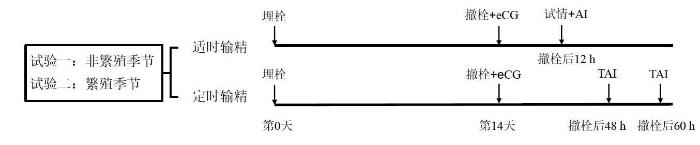
试验一:在非繁殖季节,选择体况良好、无繁殖疾病的192只罕山白绒山羊,随机分为适时输精组和定时输精组。适时输精组(n=70):母羊阴道埋植孕酮海绵栓,记为第0天,14 d后撤出孕酮栓,撤栓的同时肌肉注射eCG 330 IU;撤栓后12 h,开始用公羊试情,每天早晚2次,每次间隔12 h,每次试情1 h,连续试情4 d,发情母羊在发情后12和24 h各进行一次人工授精。定时输精组(n=122):同期发情处理和适时输精组完全一样,但母羊在撤栓后不进行发情鉴定,在撤栓后48和60 h进行两次定时输精。
试验二:在繁殖季节,选择体况良好,无繁殖疾病的192只罕山白绒山羊,随机分为适时输精组(n=72)和定时输精组(n=120)。同期发情处理和试验一完全一样。试验设计见图1
图1 同期发情处理程序

注:AI和TAI分别为人工授精和定时输精。

Fig. 1 Estrus synchronization protocol

Note: AI and TAI were artificial insemination and timed artificial insemination, respectively.

1.4 埋栓

母羊阴道周围先用消毒液清洗,之后再用生理盐水清洗3遍。把孕酮海绵栓置于埋栓枪内,埋栓枪使用前要进行消毒,并用生理盐水冲洗干净,向母羊阴道内缓慢插入埋栓枪,使孕酮海绵栓置于子宫颈口处,之后抽出埋栓枪。

1.5 发情鉴定

提前调教试情公羊,公羊与母羊隔离饲养。试情时公羊系上试情布,按1∶8比例放入羊群,母羊站立不动,接受公羊爬跨为发情判断标准。

1.6 人工授精

每只采精公羊提前1个月每天补饲0.5~1 kg胡萝卜和2~3个新鲜鸡蛋。保定好发情母羊,让公羊爬跨发情母羊采精,显微镜下检查精子密度和活力,呈云雾状且活力≥0.8的精液用脱脂牛奶按1∶2体积比稀释。母羊采用子宫颈口人工授精,每只羊输精0.2 mL。

1.7 妊娠诊断

配种后30 d左右使用直肠B超进行孕检,保定好母羊,清除直肠内粪便,探头越过膀胱后出现羊水液性暗区和孕囊为怀孕。

1.8 数据统计分析

发情时间分布为每个发情鉴定时间点发情羊只数,同期发情率、妊娠率和产羔率计算公式见式(1)(3)
同期发情率=发情羊只数/处理羊只数
妊娠率=妊娠羊只数/发情羊只数
产羔率=产羔羊只数/发情羊只数
其中式(1)只针对适时输精组。
使用SPSS 26.0软件对数据进行差异显著性分析。同期发情率、妊娠率和产羔率数据使用卡方检验分析,结果以百分比形式表示。P<0.05表示差异显著。

2 结果与分析

2.1 同期发情程序在发情季节和非发情季节效果分析

表1可知,非繁殖季节和繁殖季节之间同期发情率差异不显著(P>0.05)。发情开始时间主要同步在撤栓后24~60 h,其中在36 h发情羊数量最多,其次是48 h。
表1 罕山白绒山羊在不同季节同期发情处理后的同期发情率和发情时间分布

Table 1 Estrus synchronization rate and estrus time distribution of Hanshan white cashmere goats after estrus synchronization treatment across different seasons

项目Items 同期发情率Estrus synchronization rate/% 发情时间Estrus time/h
12 24 36 48 60
非繁殖季节Non-breeding season/只 95.71(67/70) 0 3 38 25 1
繁殖季节Breeding season/只 97.22(70/72) 0 6 47 17 0

注:括号内数据分子表示发情羊只数,分母表示处理羊只数。下表同。

Note: The numerator in parentheses indicates the number of goats showing estrus, and the denominator indicates the number of goats treated. The same applies to the tables that follow.

表2可知,无论是适时输精还是定时输精,繁殖季节的妊娠率和产羔率均显著高于非繁殖季节(P<0.05)。
表2 罕山白绒山羊在不同季节同期发情处理后的妊娠率和产羔率

Table 2 Pregnancy rate and lambing rate of Hanshan white cashmere goats after synchronization of estrus treatment in different seasons

项目Items 非繁殖季节Non-breeding season 繁殖季节Breeding season
适时输精Timely artificial insemination 妊娠率/% 68.66(46/67)b 87.14(61/70)a
产羔率/% 64.18(43/67)b 81.43(57/70)a
定时输精Timed artificial insemination 妊娠率/% 60.66(74/122)b 79.17(95/120)a
产羔率/% 57.38(70/122)b 74.17(89/120)a

注:同行数据肩标字母完全不同表示差异显著(P<0.05),含有相同字母或无字母表示差异不显著(P>0.05)。下表同。

Note: Different superscript letters within the same row indicate statistically significant differences (P<0.05), while sharing a common superscript letter or no letter indicates no significant difference (P>0.05). The same applies to the tables that follow.

2.2 输精程序在发情季节和非发情季节效果分析

表3可知,在非繁殖季节和繁殖季节,适时输精和定时输精之间妊娠率和产羔率差异均不显著(P>0.05)。
表3 罕山白绒山羊不同输精程序处理后的妊娠率和产羔率

Table 3 Pregnancy rate and lambing rate of Hanshan white cashmere goats following different insemination protocols

项目Items 适时输精Timely artificial insemination 定时输精Timed artificial insemination
非繁殖季节Non-breeding season 妊娠率/% 68.66(46/67) 60.66(74/122)
产羔率/% 64.18(43/67) 57.38(70/122)
繁殖季节Breeding season 妊娠率/% 87.14(61/70) 79.17(95/120)
产羔率/% 81.43(57/70) 74.17(89/120)

3 讨论

在本研究中,在非繁殖季节和繁殖季节,罕山白绒山羊同期发情率均达到了95%以上,这说明14 d P4-eCG方案在罕山白绒山羊上实现了良好的同期发情效果,这也与国内外其他研究团队使用P4-eCG方案在其他品种山羊上面取得的发情率结果相一致[9,12-13]
无论在适时输精或定时输精条件下,繁殖季节的妊娠率与产羔率均显著高于非繁殖季节。该差异可能是由多种因素共同导致的。前期研究显示,经P4-eCG方案处理后,繁殖季节山羊的发情持续时间及排卵期血浆雌二醇(Estradiol, E2)浓度均显著高于非繁殖季节[14]。排卵前E2在生殖过程中发挥多层次的调控作用,包括促进卵泡发育、卵母细胞成熟、精子在雌性生殖道内的运输、子宫容受性建立以及胚胎存活等[15]。在卵泡期,E2分泌的增加会触发正反馈调节机制,诱导排卵前促性腺激素释放激素峰的形成,该促性腺激素释放激素峰继而刺激黄体生成素峰的释放,最终导致排卵发生[16]。另一项研究结果表明,排卵前E2浓度的升高对产后母牛的妊娠率有积极影响[17]。因此,排卵前E2分泌不足导致卵母细胞成熟、精子运输和子宫容受性等过程受限,可能是非繁殖季节繁殖性能低的一个重要原因。此外,P4对于妊娠的建立和维持至关重要。在山羊和绵羊中,黄体P4分泌不足会导致30%~40%的胚胎死亡,进而使其妊娠率显著降低[18,19]。黄体P4分泌不足主要发生在小型反刍动物的非繁殖季节[14]。由此推测,在非繁殖季节,排卵后黄体分泌P4不足可能是造成繁殖性能低的另一个重要原因。在未来的研究中,针对罕山白绒山羊在非繁殖季节使用P4-eCG方案时,可以考虑在配种时给母羊补充E2,或者在配种后早期给母羊注射人绒毛膜促性腺激素诱导附属黄体形成并促进早期黄体分泌P4能力,以提高其繁殖性能。
罕山白绒山羊发情开始时间主要同步在撤栓后36和48 h。在生产中,母羊一般在发情后间隔8~12 h输精两次,因此,本研究把定时输精的时间点选择在撤栓后48和60 h,这样可以兼顾大多数发情羊。适时输精需要对母羊进行试情,一般至少需要在撤栓后24、36、48和60 h进行4次试情,每一次试情的发情羊需要进行两次人工授精,这极大地增加了劳动力成本、时间成本以及试情过程中抓羊所造成的应激反应。与适时输精相比,定时输精不需要进行试情并且只需要两次人工授精,特别适合规模化羊场。定时输精后结合早期妊娠诊断技术可以对未怀孕的母羊再次进行同期发情处理,从而进一步提高繁殖效率。本研究没有评估非繁殖季节和繁殖季节罕山白绒山羊同期发情处理后发情持续时间和发情开始到排卵的时间,未来可以结合直肠B超技术进一步精确评估罕山白绒山羊排卵时间,从而找到更精准的定时输精时间点。

4 结论

本研究通过探究季节和输精程序对罕山白绒山羊同期发情效果的影响,发现P4-eCG方案在罕山白绒山羊上能够实现良好的同期发情效果,繁殖季节妊娠率和产羔率显著高于非繁殖季节,综合考虑操作简便性,建议选择定时输精方案。
[1]
FATET A, PELLICER-RUBIO M T, LEBOEUF B. Reproduct-ive cycle of goats[J]. Animal Reproduction Science, 2011, 124(3/4): 211-219.

[2]
NAKAFEERO A, GONZALEZ-BULNES A, MARTINEZ-ROS P. Use of short-term CIDR-based protocols for Oestrus synchr-onisation in goats at tropical and subtropical latitudes[J]. Ani-mals, 2024, 14(11): 1560.

[3]
DUAN Z Y, LIU M H, LI J J, et al. Long-interval prostaglandin F combined with GnRH improves the estrus synchronization and reproductive performance of sheep during the breeding season[J]. Animals, 2025, 15(3): 336.

[4]
段增祎, 齐琪, 刘孟豪, 等. 来曲唑处理对绵羊同步排卵程序同期发情效果的影响[J]. 黑龙江动物繁殖, 2025, 33(4): 29-34.

DUAN Z Y, QI Q, LIU M H, et al. Effects of letrozole treatment on estrus synchronization in sheep using synchronization of ovulation protocol[J]. Heilongjiang Journal of Animal Repro-duction, 2025, 33(4): 29-34.

[5]
WALKER S K, WEAVER A C, SWINBOURNE A M S, et al. Improving the efficacy of progesterone pessary treatment for synchrony of estrus in the sheep[J]. Theriogenology, 2025, 233: 24-31.

[6]
荣威恒, 李玉荣, 孙素珍, 等. 罕山白绒山羊[J]. 中国草食动物, 2003, 23(S1): 140-141.

RONG W H, LI Y R, SUN S Z, et al. Hanshan white Cashmere goat[J]. China Herbivore Science, 2003, 23(S1): 140-141.

[7]
AMIRI B EL, RAHIM A. Exploring endogenous and exogenous factors for successful artificial insemination in sheep: a global overview[J]. Veterinary Sciences, 2024, 11(2): 86.

[8]
SPANNER E A, DE GRAAF S P, RICKARD J P. Factors affecting the success of laparoscopic artificial insemination in sheep[J]. Animal Reproduction Science, 2024, 264: 107453.

[9]
KADILI S EL, RAES M, BISTER J L, et al. Evaluation of different hormonal treatments on oestral and ovarian responses in Moroccan Beni Arouss goats during anoestrus and breeding season[J]. Reproduction in Domestic Animals, 2019, 54(7): 1003-1009.

[10]
GAFSI N, MARTIN O, BIDAN F, et al. Exploring how milk production, body weight and body condition dynamics affect reproductive success after artificial insemination in dairy goats[J]. Theriogenology, 2025, 234: 83-91.

[11]
CIZMECI S U, KIVRAK M B, TAKCI A, et al. Evaluation of hormonal protocols for induction of synchronized estrus on reproductive indices in Kangal-Akkaraman ewes during the outbreeding season[J]. Small Ruminant Research, 2022, 216: 106787.

[12]
谢周勋. 不同处理方法对戴云山羊同期发情效果的影响[J]. 畜牧兽医杂志, 2021, 40(6): 40-42.

XIE Z X. Effects of different treatments on estrus synchronization in Daiyun goats[J]. Journal of Animal Science and Veterinary Medicine, 2021, 40(6): 40-42.

[13]
尚倩倩, 杜海东, 王跟辉, 等. 非繁殖季节不同处理方法诱导中卫山羊同期发情效果研究[J]. 中国畜牧杂志, 2025, 61(2): 192-195, 202.

SHANG Q Q, DU H D, WANG G H, et al. Study on the effect of different treatments on inducing estrus synchronization in Zhongwei goat in non-breeding season[J]. Chinese Journal of Animal Science, 2025, 61(2): 192-195, 202.

[14]
BŁASZCZYK B, UDAŁA J, GĄCZARZEWICZ D. Changes in estradiol, progesterone, melatonin, prolactin and thyroxine concentrations in blood plasma of goats following induced estrus in and outside the natural breeding season[J]. Small Ruminant Research, 2004, 51(3): 209-219.

[15]
DUAN Z Y, LIU M H, LI J J, et al. Melatonin implantation improves the reproductive performance of estrus-synchronized ewes during seasonal anestrus and enhances the antioxidant and steroidogenic capacities of granulosa and luteal cells[J]. Antioxidants, 2025, 14(7): 895.

[16]
CARATY A, FRANCESCHINI I, HOFFMAN G E. Kisspeptin and the preovulatory gonadotrophin-releasing hormone/luteinising hormone surge in the ewe: basic aspects and potential applications in the control of ovulation[J]. Journal of Neuroendocrinology, 2010, 22(7): 710-715.

[17]
CIERNIA L A, PERRY G A, SMITH M F, et al. Effect of estradiol preceding and progesterone subsequent to ovulation on proportion of postpartum beef cows pregnant[J]. Animal Reproduction Science, 2021, 227: 106723.

[18]
RODRIGUES J N D, GUIMARÃES J D, OLIVEIRA M E F, et al. Human chorionic gonadotropin affects original (ovulatory) and induced (accessory) corpora lutea, progesterone concentrations, and pregnancy rates in anestrous dairy goats[J]. Reproductive Biology, 2022, 22(1): 100591.

[19]
D’ALESSANDRO A G, MARTEMUCCI G. Superovulatory response to gonadotrophin FSH/LH treatment and effect of progestin supplement to recipients on survival of transferred vitrified embryos in goats[J]. Theriogenology, 2016, 85(2): 296-301.

文章导航

/