前沿技术

畜禽肠道菌群失调与腹泻的关系及相关治疗

  • 曹宇豪 , 1, 2, 3 ,
  • 邹宇 1, 2, 3 ,
  • 胡世杰 1, 2, 3 ,
  • 牛佳琦 1, 2, 3 ,
  • 朱砺 1, 2, 3 ,
  • 赵叶 1, 2, 3 ,
  • 甘麦邻 , 1, 2, 3
展开
  • 1. 四川农业大学动物科技学院/猪禽种业全国重点实验室,四川 成都 611130
  • 2. 四川农业大学动物科技学院/农业农村部畜禽生物组学重点实验室,四川 成都 611130
  • 3. 四川农业大学动物科技学院/畜禽种质资源与生物育种四川省重点实验室,四川 成都 611130
甘麦邻(1993—),男,四川广安人,教授,研究方向:动物遗传育种与繁殖,E-mail:

曹宇豪(2001—),男,河南周口人,硕士研究生,研究方向:动物遗传育种与繁殖,E-mail:

收稿日期: 2025-11-10

  网络出版日期: 2026-06-17

基金资助

四川省科技计划(2021YFYZ0007)

四川省科技计划(2021YFYZ0030)

国家现代农业产业技术体系四川生猪创新团队(SCCXTD-2025-8)

国家生猪产业技术体系(CARS-35)

Relationship between intestinal dysbiosis and diarrhea in livestock and poultry, and related treatments

  • Yuhao Cao , 1, 2, 3 ,
  • Yu Zou 1, 2, 3 ,
  • Shijie Hu 1, 2, 3 ,
  • Jiaqi Niu 1, 2, 3 ,
  • Li Zhu 1, 2, 3 ,
  • Ye Zhao 1, 2, 3 ,
  • Mailin Gan , 1, 2, 3
Expand
  • 1. College of Animal Science and Technology, Sichuan Agricultural University, State Key Laboratory of Pig and Poultry Breeding Industry, Chengdu, 611130, Sichuan
  • 2. College of Animal Science and Technology, Sichuan Agricultural University, Key Laboratory of Livestock and Poultry Functional Omics, Ministry of Agriculture and Rural Affairs, Chengdu, 611130, Sichuan
  • 3. College of Animal Science and Technology, Sichuan Agricultural University, Key Laboratory of Livestock and Poultry Germplasm Resources and Biotechnology Breeding, Sichuan Province, Chengdu, 611130, Sichuan

Received date: 2025-11-10

  Online published: 2026-06-17

摘要

畜禽腹泻是全球畜牧业面临的重大健康挑战,传统依赖抗生素的防治策略面临耐药菌扩散及药物残留等严峻局限。该文系统梳理了畜禽肠道菌群组成与功能,分析了菌群失调通过破坏肠道屏障、扰乱分泌功能及免疫调节引发腹泻的机制,并阐述了四大干预策略:一是以益生菌(如乳杆菌、芽孢杆菌)、益生元(如低聚果糖、菊粉)及合生元为核心的微生态制剂调控;二是涵盖日粮优化与功能性添加剂(有机酸、酶制剂、植物提取物)的营养调控;三是抗生素的合理使用及其替代品(噬菌体、抗菌肽、卵黄抗体)的应用;四是粪菌移植技术。这些策略在降低腹泻发生率、替代抗生素治疗方面展现出巨大潜力,但仍面临菌株定植效率低、跨物种标准化不足、生物安全风险等挑战。未来需深入解析关键功能菌群作用机制,研发高靶向性微生态制剂,整合多组学数据构建菌群-宿主互作网络,建立精准防控体系,推动绿色健康养殖。

本文引用格式

曹宇豪 , 邹宇 , 胡世杰 , 牛佳琦 , 朱砺 , 赵叶 , 甘麦邻 . 畜禽肠道菌群失调与腹泻的关系及相关治疗[J]. 中国畜禽种业, 2026 , 22(5) : 21 -31 . DOI: 10.19543/j.cnki.1673-4556.20260330.001

Abstract

Diarrhea in livestock and poultry constitutes a major health challenge to the global animal husbandry industry. Traditional prevention and control strategies that rely heavily on antibiotics are plagued by severe limitations, including the spread of antimicrobial-resistant bacteria and drug residues. In this paper, the composition and function of intestinal flora in livestock and poultry are systematically reviewed, and the mechanism of dysbacteriosis causing diarrhea, which involves destroying the intestinal barrier, disrupting secretory function, and immune regulation, is analyzed. Four intervention strategies were described: First, probiotics ( such as Lactobacillus, Bacillus ), prebiotics ( such as fructooligosaccharides, inulin ) and synbiotics were used as the core of probiotics regulation; the second is to cover diet optimization and nutritional regulation of functional additives ( organic acids, enzyme preparations, plant extracts ); third, the rational use of antibiotics and their substitutes ( phages, antimicrobial peptides, egg yolk antibodies ); fourth, fecal bacteria transplantation technology. These strategies hold great potential for reducing the incidence of diarrhea and replacing antibiotic therapy, yet they still face challenges such as low strain colonization efficiency, insufficient cross-species standardization, and biosafety risks. Moving forward, it is essential to further elucidate the mechanisms of action of key functional microbiota, develop highly targeted microecological preparations, integrate multi-omics data to construct microbiota-host interaction networks, establish a precise prevention and control system, and advance green and healthy breeding practices.

畜禽腹泻是全球畜牧业的重大健康挑战,其高发病率导致生长受阻、饲料转化率下降及死亡率攀升,造成巨额经济损失。传统依赖抗生素的防治策略面临严峻局限,全球90%抗生素用于食用动物,直接导致耐药菌扩散及药物残留[1,2]。经丹麦、英国、法国等国家研究证实,抗菌药用量与大肠杆菌耐药性呈强正相关,且耐药基因岛在动物源弯曲菌中流行,可能经食物链传播至人类[3]。肠道微生态系统被视为畜禽消化、代谢与免疫稳态的核心调控枢纽,其组成受遗传、分娩、母源及环境等多因素影响。有研究表明,畜禽肠道菌群失调会削弱黏肠道液屏障、下调紧密连接蛋白、诱发低度炎症并扰乱水电解质转运,最终触发渗透性、分泌性或出血性腹泻[4]。在此背景下,本文系统梳理了畜禽肠道菌群的组成功能,分析菌群失调与腹泻之间的关系,探究其产生的作用机制,并提出相关精准干预策略,为畜禽腹泻减少抗生素使用、保障肠道健康与实现可持续养殖提供理论支持。

1 畜禽肠道菌群概述

1.1 肠道菌群的组成与定植

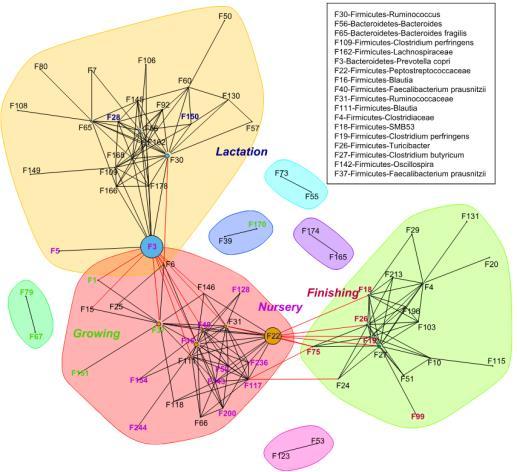
畜禽肠道菌群主要由厚壁菌门(Firmicutes)、拟杆菌门(Bacteroidetes)、变形菌门(Proteobacteria)和放线菌门(Actinobacteria)四大核心菌门构成,其相对丰度及代表性菌属具有显著的物种特异性。厚壁菌门在家禽中以乳酸杆菌属(Lactobacillus)和罗姆布茨菌属(Romboutsia)为主,在牛中则以瘤胃球菌科成员为优势类群,而猪肠道中则以乳酸杆菌属和狭义梭菌属(Clostridium sensu stricto)为代表[5,6]。拟杆菌门在断奶仔猪中丰度较高,其典型菌属包括拟杆菌属(Bacteroides),而变形菌门在新生阶段中占比较高,以肠杆菌科(Enterobacteriaceae)为特征[7]。放线菌门则以双歧杆菌属(Bifidobacterium)为代表,尤其在哺乳期动物中发挥重要代谢功能[8]图1)。
图1 不同生长阶段细菌分类之间相互作用的网络分析9

Fig. 1 Network analysis of interactions between bacterial taxa at different growth stages

菌群的定植过程始于出生阶段,其母体分娩方式对初始菌群的获取起到决定性影响。自然分娩的幼畜通过母体阴道接触获得以乳酸杆菌属、普雷沃菌属为主的微生物群落,而剖腹产个体则主要定植于环境菌[9-10]。菌群的母源传递可通过多种途径实现,如母猪的阴道分泌物、初乳及粪便微生物直接贡献了仔猪早期肠道菌群,其中乳酸杆菌属可经母乳垂直传递给幼畜;类似地,奶牛通过肠道-乳腺轴将微生物经乳汁传递给犊牛(图2),禽类胚胎则通过卵白携带母源微生物定植[11,12]。卫生条件、抗生素使用及管理操作等一些早期环境因素会进一步扰动定植进程。如抗生素处理的新生仔猪表现为厚壁菌门中瘤胃球菌科丰度下降,而变形菌门增加,同时伴随免疫基因表达抑制[13]。畜禽肠道菌群的组成与定植受宿主遗传、分娩方式、母源微生物输入及早期环境暴露等多层次因素的动态调控有关,这些过程共同塑造了菌群结构的个体差异与核心稳定性。
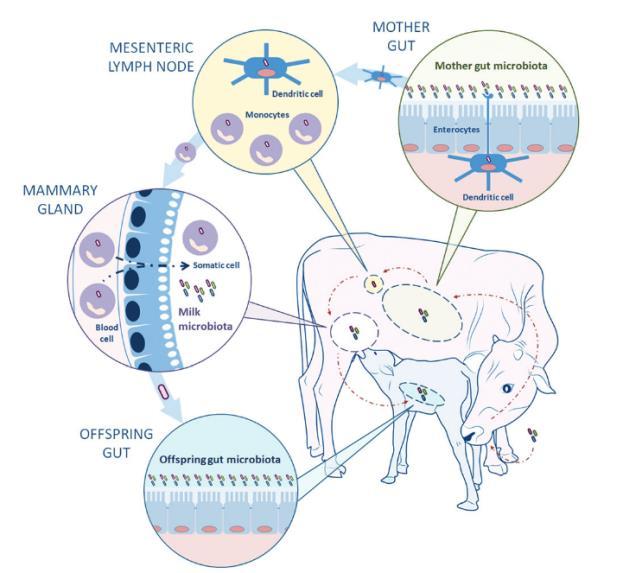
图2 反刍动物和它们的母子微生物流的肠-乳腺途径假说12

Fig. 2 Hypothesis of the intestinal-mammary gland pathway for maternal-offspring microbial flow in ruminants

1.2 肠道菌群的主要功能

畜禽肠道菌群是动物消化道内复杂的微生物生态系统,其功能涵盖营养代谢、屏障保护、免疫调节及肠道动力与黏膜发育等多个方面。在营养代谢方面,肠道菌群通过发酵宿主难以消化的膳食纤维产生短链脂肪酸,其中双歧杆菌(Bifidobacterium)、苏特拉氏菌(Sutterella)和布拉氏菌(Blautia)等菌属主导乙酸的合成,而丙酸杆菌(Propionibacterium)和丁酸梭菌(Clostridium butyricum)则分别负责丙酸与丁酸的生成;短链脂肪酸(Short-chain fatty acids,SCFAS)不仅为宿主肠上皮细胞提供能量,还通过激活GPR41/GPR43受体调节宿主葡萄糖稳态与脂质代谢,如丁酸通过cAMP依赖机制促进肠道葡萄糖异生,丙酸则通过肠-脑神经回路调控能量平衡[14-16]
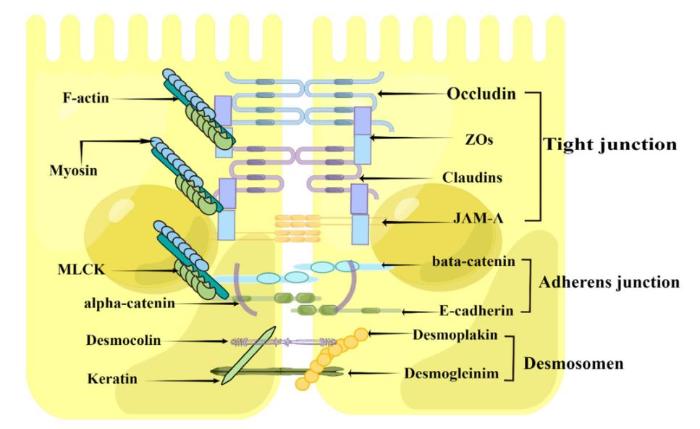
此外,菌群合成维生素K及B族维生素,作为内源性营养素支持宿主代谢与红细胞生成。在屏障保护功能中,菌群通过竞争性排斥病原体定植位点、分泌抗菌物质以及维持黏液层完整性实现物理化学防御(图3);黏液层主要由杯状细胞分泌的黏蛋白(如MUC2)构成,其厚度与成分受菌群调节,如丙酸杆菌的补充可增加杯状细胞数量与中性黏蛋白分泌,从而增强黏液屏障[17-18]。共生菌群还通过代谢产物降低肠道pH,抑制沙门氏菌等需氧病原体的扩增[19]
图3 肠上皮屏障的构建20

Fig. 3 Establishment of the intestinal epithelial barrier

在免疫调节方面,肠道菌群通过“训练免疫”机制促进免疫系统发育。早期菌群定植刺激模式识别受体信号通路,调控T细胞分化,并诱导宿主防御肽的表达以增强黏膜免疫[20]。丁酸梭菌等益生菌通过上调抗炎因子IL-10、下调促炎因子TNF-α和IL-1β,平衡Th17/Treg应答,减轻肠道炎症[21]。β-葡聚糖等益生元可激活巨噬细胞和树突细胞,增强吞噬功能及细胞因子分泌,形成“先天免疫记忆”[22]
对于肠道动力与黏膜发育,菌群通过SCFAs刺激肠神经丛活性,加速肠内容物排空;同时调控隐窝干细胞增殖与分化,例如罗伊氏乳杆菌通过激活STAT3和Wnt/β-catenin信号通路促进肠上皮再生,而甘露寡糖直接或间接增加绒毛长度与隐窝深度,优化营养吸收表面积[23]。菌群缺失则导致黏膜发育迟滞,如无菌鸡小肠杯状细胞数量减少50%,黏蛋白MUC2表达显著降低[24]。肠道菌群通过多维度功能协同维持宿主稳态,其失调将直接引发腹泻等肠道疾病。

1.3 影响畜禽肠道菌群的因素

畜禽肠道菌群的组成与稳定性受多重因素调控。在宿主因素方面,不同品种的遗传背景显著影响菌群结构,如肉鸡现代品系与1957年雅典随机血统相比,其盲肠中卷曲乳杆菌(Lactobacillus crispatus)丰度存在显著差异,且肠道发育速度与菌群成熟度呈正相关[25]。遗传力分析表明,猪15周龄菌群多样性的遗传力为低至中度,并与背膘厚度等经济性状存在遗传相关性[26],而牛模型中父系基因组通过调控黏膜健康相关SNP间接影响菌群互作网络[27]
日粮因素对菌群的调控作用最为直接。饲料成分中,玉米-豆粕型日粮与鱼副产品饲料相比,虽对消化道形态影响较小,但通过变性梯度凝胶电泳可检测到菌群聚类分离[25];陈化粳稻糙米替代25%玉米可提高盲肠乳杆菌丰度,但需添加0.025%胆汁酸以缓解脂质氧化对菌群的负面影响,并降低背膘厚。日粮结构的调整同样会抑制菌群多样性,导致乳杆菌与梭菌比例失衡。添加剂中,丁酸梭菌通过产生丁酸增强肠道屏障功能[28],而益生菌与酵母发酵产物组合可提高瘤胃菌群中纤维降解菌的丰度,改善营养物质代谢[29]
环境与管理因素中,饲养密度超过20只/m²时,肉鸡盲肠菌群α多样性显著下降,厚壁菌门与拟杆菌门比例失调,并伴随121种代谢物含量异常,导致紧密连接蛋白Occludin表达下调及促炎因子(TNF-α、IL-6)上调[30]。在养殖的卫生条件方面,垫料质量差可增加沙门氏菌定植风险,而生物安全措施不足会加剧病原体经粪-口途径传播[31]。而热应激等环境压力通过激活下丘脑-垂体-肾上腺轴,破坏菌群-肠-脑轴双向调控,减少短链脂肪酸产生菌[32]
疾病与用药的干预深刻改变菌群生态。病原体感染诱发坏死性肠炎,导致盲肠梭菌目细菌扩增[33],而沙门氏菌感染可竞争性抑制乳杆菌定植。抗生素滥用使猪肠道红霉素耐药肠球菌比例达90%,禁用后降至28.1%;类似地,丹麦禁用维吉尼亚霉素后,肉鸡粪便中耐药肠球菌比例从66.2%降至33.9%[34]。化学药物虽可控制感染,但长期使用减少菌群β多样性,微生态制剂则通过恢复厌氧菌优势维持菌群稳态[35]

2 肠道菌群失调与腹泻的病理关系

2.1 肠道菌群失调的定义与类型

肠道菌群失调(dysbiosis)是指肠道微生物生态失衡,其表现为菌群多样性下降、结构紊乱及功能异常,导致保护性菌群与有害菌群平衡破坏。Pires等[36]指出,分类失调表现为微生物物种组成失衡,如乳酸杆菌和双歧杆菌等有益菌减少,而大肠杆菌、沙门氏菌及梭菌等条件致病菌过度增殖;功能失调则体现为代谢产物异常,如SCFAs合成减少,而脂多糖(Lipopolysaccharides,LPS)等有害代谢物增加(图4)。Wu等[37]对腹泻牦牛的研究进一步证实,腹泻组致肠道屏障损伤和免疫失衡。Zhang等[38]通过抗生素诱导鸡肠道菌群失调模型,发现变形菌门(Proteobacteria)增殖导致代谢组学紊乱,SCFAs合成基因表达受抑,同时脂质生成相关有害代谢物积累,易加剧腹泻发生。
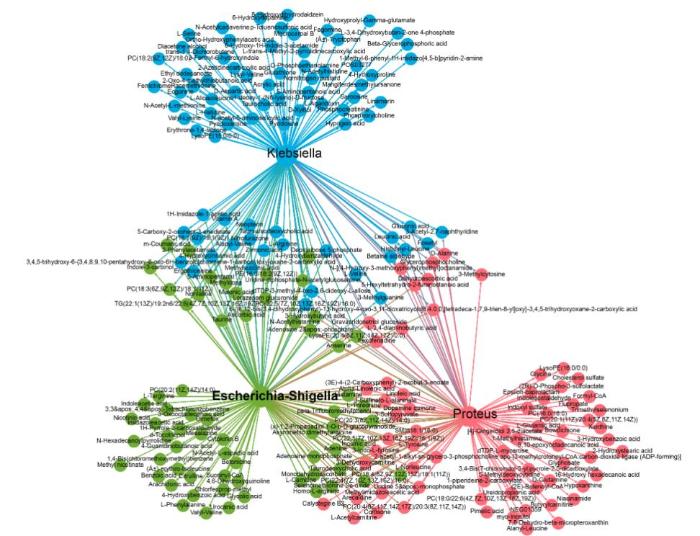
图4 大肠杆菌-志贺氏菌、克雷伯氏菌和变形杆菌之间的相关网络以及差异代谢物36

注:不同颜色代表不同的簇,(正常脂肪饮食,n=4),(含抗生素的正常脂肪饮食,n=5)

Fig. 4 Correlation network and differential metabolites among escherichia coli–shigella, klebsiella and proteus

Note: Different colors represent different clusters, (Normal fat diet, NFD, n=4), (Normal fat diet with antibiotics, NFDA, n=5)

2.2 导致菌群失调和腹泻的主要诱因

病原微生物感染是诱发畜禽肠道菌群失调和腹泻的核心因素,病毒、细菌及寄生虫通过直接破坏肠黏膜屏障和微生态平衡引发腹泻[38]。ETEC通过黏附素K99/F41定植肠黏膜,分泌热稳定肠毒素和热不稳定肠毒素,激活肠细胞cAMP/cGMP信号通路,导致氯离子与水分大量分泌,引发分泌性腹泻[39]。寄生虫感染则通过物理损伤黏膜层,为条件致病菌提供入侵途径[40]
抗生素滥用是菌群失调的另一关键诱因,广谱抗生素无差别抑制共生菌群,导致艰难梭菌等机会致病菌过度繁殖[41]。Theriot等[42]通过小鼠模型证实,抗生素可抑制次级胆汁酸的生物转化,而次级胆汁酸本是抑制艰难梭菌孢子萌发的关键物质,其减少直接促进病原体定植与毒素产生。陈胜宏等[43]研究进一步指出,禽类滥用抗生素可破坏肠上皮紧密连接蛋白表达,削弱肠道物理屏障功能,同时抑制免疫细胞发育及细胞因子分泌,加剧肠道炎症反应与腹泻风险。
日粮因素通过营养成分失衡直接干扰菌群代谢功能。霉变饲料中的黄曲霉毒素B1抑制瘤胃细菌纤维素降解活性,降低SCFAs产量,削弱肠道屏障功能[44]。舒雁等[45]研究证实,低纤维高蛋白日粮减少SCFAs生成,影响肠上皮能量供应和紧密连接蛋白表达,导致水电解质吸收障碍。此外,日粮突然转换或抗营养因子可诱发菌群结构剧变,兼性厌氧菌增殖取代专性厌氧菌,乳酸积累导致代谢性酸中毒和腹泻[46]
应激反应通过神经内分泌途径介导菌群紊乱。断奶应激激活下丘脑-垂体-肾上腺轴,释放皮质酮和去甲肾上腺素,抑制双歧杆菌等有益菌生长,同时促进大肠杆菌增殖[47]。Sudo等[48]研究发现,应激激素通过β2-肾上腺素受体信号通路抑制肠上皮细胞增殖,增加凋亡率,破坏黏膜物理屏障。热应激则通过HSP70/TLR4/STAT6通路下调紧密连接蛋白表达,增加肠道通透性,并减少乳杆菌等耐酸菌丰度,加剧菌群失衡。以上诱因会通过破坏菌群多样性、抑制SCFAs生成、损伤肠黏膜屏障及激活炎症通路等多途径导致腹泻,其中病原微生物和抗生素的直接影响最为直接,而日粮与应激则通过代谢和神经内分泌机制间接加剧失调。

2.3 菌群失调引起腹泻的主要机制

畜禽肠道菌群失调引起的动物腹泻机制涉及多维度因素的相互作用。Sarmento等[49]指出,肠道菌群失调(dysbiosis)定义为宿主微生物环境的病理性改变,主要表现为有益微生物丧失、病原体扩增及微生物多样性降低。Hamed等[50]发现肠道菌群失调时,致病性大肠杆菌、产气荚膜梭菌等条件致病菌,可激活肠上皮细胞Fas/FasL凋亡通路,破坏黏膜屏障,直接诱发渗透性腹泻。仔猪ETEC感染模型中,ETEC借菌毛F41黏附肠上皮,其分泌的溶血素上调FasL表达;FasL与Fas受体结合后激活caspase-8/caspase-3级联反应,使肠上皮细胞凋亡率从5%升至22%,肠道通透性增加30%,引发水电解质吸收障碍;用Fas抗体阻断该通路,仔猪腹泻率降低45%[51]。肉鸡坏死性肠炎模型中,产气荚膜梭菌α毒素以类似机制激活Fas/FasL通路,致盲肠上皮凋亡、绒毛断裂,与TLR4/NF-κB通路协同加剧损伤;补充丁酸梭菌可下调FasL,将凋亡率控制在8%内,缓解腹泻[52]。该通路靶向肠上皮存活,是致病菌致腹泻的关键启动环节。从诱因分析,刘力等[53]指出抗生素滥用是畜禽菌群失调的主要驱动因素,其通过摧毁微生物屏障、促进耐药菌株增殖,破坏微生态平衡。以沙星类药物为例,我国畜牧业年用量达6000 t,导致多重耐药沙门氏菌株广泛存在,进一步加剧肠道稳态失衡[53]
应激因素为核心诱因,Siddiqui等[54]指出畜禽肠道菌群可通过神经、内分泌及免疫途径调控中枢神经系统,进而影响肠道功能,其中“菌群代谢物-迷走神经”“菌群-LPS-HPA轴”是两条关键信号通路,在畜禽应激性肠道紊乱中起主导作用。仔猪断奶应激致菌群失调(乳杆菌减、大肠杆菌增),菌群产生的LPS入血激活HPA轴,皮质酮增多,通过β2-肾上腺素受体抑制肠上皮增殖,使绒毛高度降低15%;补充罗伊氏乳杆菌可调节菌群减少LPS入血,其代谢物乙酸激活迷走神经,抑制HPA轴过度激活,恢复皮质酮水平,缓解肠道损伤;禽类热应激致盲肠菌群多样性降、γ-氨基丁酸(Gama-aminobutyric acid,GABA)减,GABA不足使肠道排空慢30%,食糜滞留加重菌群失衡,补充产GABA植物乳杆菌可恢复肠道动力,降腹泻率[55-57]。该轴揭示双向调控机制,为益生菌+环境调控等综合干预提供依据。Ringseis等[58]补充认为此类菌群失调可致紧密连接破坏、肠通透性增加,加速病原体及毒素易位,菌群失调导致黏液层结构破坏[58]。Van等[59]发现Muc2基因敲除小鼠自发结肠炎,证明黏液屏障完整性对预防炎症不可或缺。
菌群紊乱还会削弱紧密连接蛋白表达,如热应激猪回肠occludin mRNA显著下调,伴随血浆内毒素水平升高。而徐灵齐[60]的动物实验则证实,TLR4/NF-κB通路激活上调IL-1β、IL-6及TNF-α表达,加重肠道炎症及水肿。菌群失调显著降低SCFAs产量。在牦牛腹泻模型中,Li等[61]发现SCFAs总量下降,伴随丁酸浓度降低与腹泻严重度正相关;宏基因组分析显示产SCFAs菌群丰度减少,而致病性大肠杆菌(Escherichia-Shigella)扩增。

3 基于肠道菌群调控的腹泻防治策略

3.1 微生态制剂

微生态制剂作为调控畜禽肠道菌群的核心策略,主要包括益生菌、益生元及合生元三类。其中益生菌被定义为“当以足够剂量给药时对宿主健康有益的活微生物”,常用菌株涵盖乳酸杆菌属、双歧杆菌属、芽孢杆菌属及酵母菌[62,63]。张津慎等[64]研究表明,益生菌可显著降低仔猪断奶后腹泻发生率达21.2%,并提高日增重14.3%;枯草芽孢杆菌PB6通过抑制产气荚膜梭菌增殖,减少鸡坏死性肠炎病变评分30%[65];犊牛饲喂嗜酸乳杆菌后腹泻发病率降低至3.5%,优于抗生素对照组[66]
益生元作为选择性发酵成分,通过刺激宿主固有有益菌生长与活性而改善健康,主要包括低聚果糖、低聚半乳糖、菊粉及甘露寡糖等[67]。其机制依赖于肠道微生物发酵产生SCFAs,降低肠腔pH,抑制病原体增殖,同时促进双歧杆菌等益生菌扩增[68]。Ignatiou等[69]指出菊粉可使仔猪粪便中乳杆菌数量提升2倍,并降低大肠杆菌载量。益生元与益生菌的协同形成合生元,如低聚果糖与乳杆菌组合可提高益生菌存活率50%,增强SCFAs产量,进而优化肠道微生态平衡。
合生元通过益生元支持益生菌定植与代谢,实现“1+1>2”效应。在仔猪模型中,含乳酸杆菌与菊粉的合生元使腹泻率降至2.41%,显著低于单一制剂组[70];肉鸡饲喂含Bacillus subtilis与甘露寡糖的合生元后,回肠绒毛高度/隐窝深度比值提升49.1%,表明肠道吸收功能增强[71]。Yadav等[72]强调合生元通过“免疫调节-病原拮抗-屏障修复”多维机制恢复肠道稳态,尤其适用于坏死性肠炎及病毒性腹泻的防控。
目前多项meta分析及系统评价显示微生态制剂对畜禽肠道健康的调控效果存在差异[64-66]。益生菌中,乳酸杆菌属与芽孢杆菌属可降低仔猪断奶腹泻率20%~30%,芽孢杆菌属抗逆性更优,枯草芽孢杆菌PB6改善仔猪坏死性肠炎效果优于乳酸杆菌属[65];肉鸡中枯草芽孢杆菌提升肠道绒毛高度/隐窝深度比值更显著,蛋鸡产蛋期则乳酸杆菌属降低肠道通透性更优[63-65]。益生元使用具有动物特异性,肉鸡中低聚果糖、犊牛中菊粉效果更佳[66,67]。合生元协同效应突出,仔猪、犊牛相关合生元腹泻率分别低至2.41%、3.5%以下,且肠道短链脂肪酸含量显著提升[70,71]。从跨模型来看,制剂对仔猪、犊牛的腹泻缓解效果(25%~35%)优于禽类(15%~25%)。制剂特性、动物自身条件、应用场景等均影响使用效果,如益生菌菌株功能有别,幼龄动物响应更强,病原感染时合生元更优,适宜剂量与提前干预效果更佳[64,65,68];目前研究存在异质性高、跨物种标准化不足等问题,未来需开展标准化试验,结合多组学解析机制,推动精准应用。

3.2 营养调控

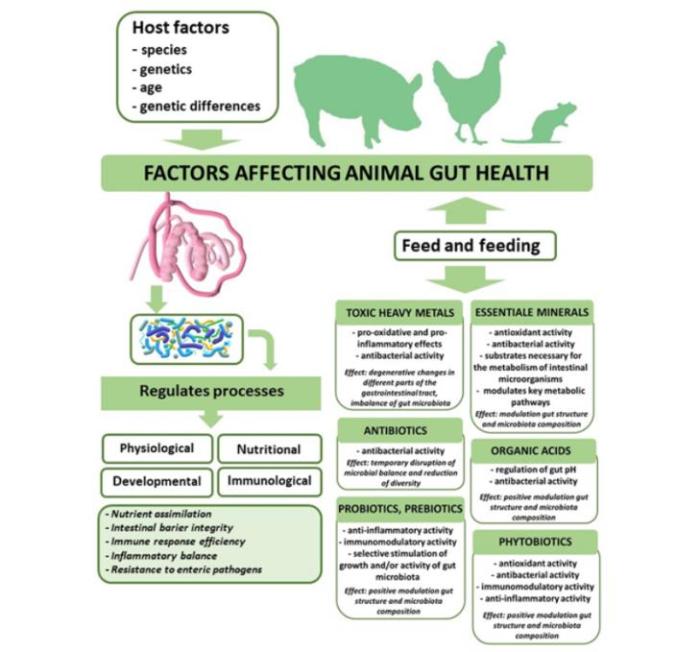
营养调控在于优化日粮配方与添加功能性饲料添加剂。优化日粮配方需关注可消化性、纤维水平及蛋白来源与水平,如通过提高可消化蛋白比例减少后肠未消化蛋白的发酵,从而抑制病原菌增殖(图5)。张龙舟等[73]指出,日粮中可溶性纤维的合理添加可促进乳酸菌等有益菌定植,而过高纤维则可能加剧后肠发酵负担。在功能性饲料添加剂方面,有机酸及其盐通过降低肠道pH值,选择性抑制大肠杆菌等病原菌生长,同时促进双歧杆菌增殖。Winiarska-Mieczan等[74]证实丁酸盐可增强肠绒毛高度/隐窝深度比,改善肠道形态并降低腹泻率。而不同种类畜禽所需要的要求也不同,如猪需平衡蛋白与纤维比例,避免后肠发酵紊乱。断奶仔猪日粮中添加0.025%胆汁酸,可缓解陈化粳稻糙米替代玉米引发的菌群失衡,提升盲肠乳杆菌丰度[75];低纤维高蛋白日粮易致仔猪肠道通透性增加,需搭配丁酸梭菌维持屏障功能;鸡注重饲料消化率与肠道环境适配。肉鸡日粮中添加酶制剂(如植酸酶)可降低食糜黏度,减少兼性厌氧菌增殖[35];蛋鸡产蛋期补充β-葡聚糖,可激活肠道巨噬细胞,提升免疫应答,效果优于其他添加剂;牛重点优化瘤胃发酵底物。奶牛日粮中添加Saccharomycescerevisiae发酵产物,可降低黄曲霉毒素B1对瘤胃菌群的破坏,维持拟杆菌门丰度稳定;犊牛代乳料中添加乳糖可促进双歧杆菌增殖,避免乳酸积累引发的酸中毒[12]
图5 影响动物肠道健康的因素70

Fig. 5 Factors affecting animal intestinal health

酶制剂通过提升养分消化率,减少后肠发酵底物,缓解菌群失调。Kiarie等[76]强调其通过限制底物可用性调控微生物群落组成,降低食糜黏度与病原菌数量。植物提取物则通过酚类化合物发挥广谱抗菌、抗炎及抗氧化作用,Fandakl等[77]验证其可显著抑制沙门氏菌并缓解肠道炎症。功能性氨基酸如谷氨酰胺和精氨酸,通过维护肠上皮紧密连接蛋白表达及增强免疫细胞功能保护肠道屏障。此外,刘秋瑾等[78]强调黄曲霉毒素B1等可破坏肠黏膜完整性,而添加蒙脱石等吸附剂可有效减毒。

3.3 合理使用抗生素与寻求替代品

精准用药要求依据病原诊断结果选择性使用抗生素,避免预防性滥用,以减轻对肠道菌群稳定性的破坏(图6)。Upadhaya等[79]指出抗生素滥用会显著降低微生物多样性、增加耐药基因转移风险并削弱宿主免疫功能。替代品探索聚焦于靶向性强且不易诱发耐药性的方案:噬菌体通过特异性裂解病原菌发挥治疗作用,Desiree等[80]的荟萃分析证实噬菌体疗法可使猪体内目标病原菌载量显著降低,且对幼龄动物效果更优;抗菌肽通过破坏病原菌膜结构实现广谱抗菌,Peng等[81]强调其在维持肠道屏障完整性及调节菌群分布中的核心作用;卵黄抗体则通过中和病原体毒素控制腹泻,王通[82]研发的抗ETEC多价卵黄抗体对菌毛抗原效价达1∶32000,灌胃治疗显著降低大鼠腹泻率并缓解肠道炎症。
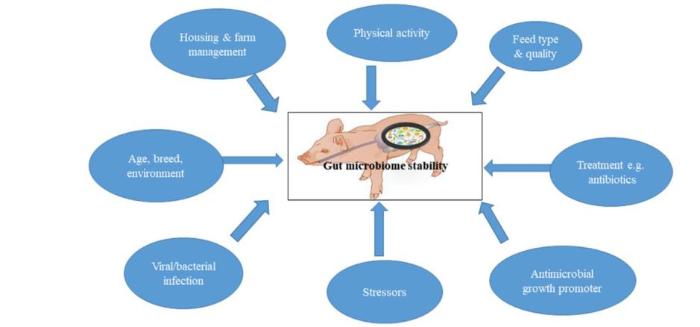
图6 肠道微生物紊乱的影响因素82

Fig. 6 Influencing factors of intestinal microbial disorders

3.4 粪菌移植

粪菌移植(Fecal microbiota transplantation,FMT)是将健康供体的全肠道微生物群通过移植至患病受体肠道内,以重建肠道微生态平衡的治疗技术。在畜禽腹泻防治中,尤其针对幼龄动物,FMT展现出可观潜力,Kim等[83]犊牛试验表明,FMT可显著降低腹泻发生率,促进肠道菌群成熟化,并提升生长性能。Su等[84]在腹泻仔猪模型中证实FMT能重塑菌群结构,上调有益菌群并修复肠黏膜屏障功能。韩齐[85]进一步指出人工哺乳仔猪经FMT干预后日增重提高15.2%,且结肠炎症通路(如NF-κB)表达下调。标准化制备流程中,Hu等[86]强调新鲜粪菌需在2 h内处理,冻存时需添加甘油保护剂,而自动化制备设备(如GenFMTer)可降低不良反应风险。Bell等[87]发现FMT对幼驹腹泻缓解率无统计学显著提升,提示需优化移植时机与频次。FMT通过微生物群整体移植实现肠道生态重建,为畜禽腹泻提供了创新干预策略。

4 结语与展望

当前研究发现畜禽肠道菌群失调会引起菌群结构及功能失衡,通过削弱黏液屏障、下调连接蛋白表达、过度释放促炎因子等行为,诱导肠上皮能量代谢紊乱与运动功能失调,从而使畜禽发生渗透性分泌性腹泻。微生态制剂、营养调控及粪菌移植等人为对畜禽肠道菌群进行靶向重建的干预手段,在降低腹泻发生率、替代抗生素治疗方面具有巨大潜力,但其作用效能受限于菌株定植的稳定性、剂量-效应的关系及跨物种的差异性。
然而,现有研究对宿主-菌群互相作用的分子路径尚不明晰,尤其是缺乏特定病原背景下的动态网络模型;而微生态制剂、FMT等特定人为干预方式在稳定性、标准化供体筛选、制备质控及生物安全监管等方面还有待深入探究,多组学数据整合深度不足,难以量化菌群-代谢-免疫-表型的因果链关系。
未来应聚焦畜禽腹泻防控的核心瓶颈与产业需求,深度解析关键功能菌群(如产短链脂肪酸的双歧杆菌、丁酸梭菌,抑病性乳酸杆菌等)的特异性作用节点,明确其在维持黏液屏障、调节免疫平衡中的信号转导机制,包括SCFAs通过GPR41/GPR43受体调控代谢、益生菌下调Fas/FasL凋亡通路的分子网络等。同时,针对现有制剂定植效率低、跨物种适配性差的问题,研发兼具高抗逆性与靶向性的新一代微生态制剂,通过菌株筛选与基因工程改造,优化益生菌-益生元协同组合,建立标准化评价体系。此外,需深度融合宏基因组、宏转录组、代谢组等多组学数据,系统构建“菌群-基因-代谢物-肠道表型”关联图谱,量化菌群与宿主的互作因果关系。最终整合上述研究成果,推动建立“风险预警-精准干预-效果评估”的全链条防控体系,有效替代抗生素,为绿色健康养殖提供坚实的理论依据与高效的技术支撑。

[1]
吕颖捷, 黄敏, 柴凤兰, 等. 畜禽养殖中抗生素的使用现状、问题及对策[J]. 中兽医学杂志, 2024(5): 43-45.

LV Y J, HUANG M, CHAI F L, et al. Present situation, problems and countermeasures of antibiotic use in livestock and poultry breeding[J]. Chinese Journal of Traditional Veterinary Science, 2024(5): 43-45.

[2]
陈红英, 王月颖, 傅思武. 抗生素在养殖业中的应用现状[J]. 现代畜牧科技, 2019(5): 1-3.

CHEN H Y, WANG Y Y, FU S W. Application status of antibiotics in aquaculture[J]. Modern Animal Husbandry Science & Technology, 2019(5): 1-3.

[3]
CHANTZIARAS I, BOYEN F, CALLENS B, et al. Correlation between veterinary antimicrobial use and antimicrobial resistance in food-producing animals: A report on seven countries[J]. The Journal of Antimicrobial Chemotherapy, 2014, 69(3): 827-834.

[4]
KONG Q H, ZHANG W Q, AN M, et al. Characterization of bacterial microbiota composition in healthy and diarrheal early-weaned Tibetan piglets[J]. Frontiers in veterinary science, 2022, 9: 799862.

[5]
BOUKERB A M, NOËL C, QUENOT E, et al. Comparative analysis of fecal microbiomes from wild waterbirds to poultry, cattle, pigs, and wastewater treatment plants for a microbial source tracking approach[J]. Frontiers in microbiology, 2021, 12: 697553.

[6]
GUO C Y, JI S K, YAN H, et al. Dynamic change of the gastrointestinal bacterial ecology in cows from birth to adulthood[J]. MicrobiologyOpen, 2020, 9(11): e1119.

[7]
FRESNO RUEDA A, SAMUEL R, ST-PIERRE B. Investigating the effects of a phytobiotics-based product on the fecal bacterial microbiome of weaned pigs[J]. Animals, 2021, 11(7): 1950.

[8]
HEINRITZ S N, MOSENTHIN R, WEISS E. Use of pigs as a potential model for research into dietary modulation of the human gut microbiota[J]. Nutrition research reviews, 2013, 26(2): 191-209.

[9]
RUTAYISIRE E, HUANG K, LIU Y H, et al. The mode of delivery affects the diversity and colonization pattern of the gut microbiota during the first year of infants' life: a systematic review[J]. BMC Gastroenterology, 2016, 16(1): 86.

[10]
DOMINGUEZ-BELLO M G, COSTELLO E K, CONTRERAS M, et al. Delivery mode shapes the acquisition and structure of the initial microbiota across multiple body habitats in newborns[J]. Proceedings of the National Academy of Sciences of the United States of America, 2010, 107(26): 11971-11975.

[11]
ADDIS M F, TANCA A, UZZAU S, et al. The bovine milk microbiota: insights and perspectives from-omics studies[J]. Molecular BioSystems, 2016, 12(8): 2359-2372.

[12]
GONG H Z, WANG T P, WU M, et al. Maternal effects drive intestinal development beginning in the embryonic period on the basis of maternal immune and microbial transfer in chickens[J]. Microbiome, 2023, 11(1): 41.

[13]
SCHOKKER D, ZHANG J, ZHANG L L, et al. Early-life environmental variation affects intestinal microbiota and immune development in new-born piglets[J]. PLoS One, 2014, 9(6): e100040.

[14]
NICHOLS RG, DAVENPORT ER. The relationship between the gut microbiome and host gene expression: a review[J]. Human Genetics, 2021, 140(5):747-760.

[15]
LIU L X, LI Q Q, YANG Y J, et al. Biological function of short-chain fatty acids and its regulation on intestinal health of poultry[J]. Frontiers in Veterinary Science, 2021, 8: 736739.

[16]
LIU J, TAN Y Z, CHENG H, et al. Functions of gut microbiota metabolites, current status and future perspectives[J]. Aging and Disease, 2022, 13(4): 1106-1126.

[17]
TANG X P, XIONG K N, FANG R J, et al. Weaning stress and intestinal health of piglets: a review[J]. Frontiers in Immunology, 2022, 13: 1042778.

[18]
MARTÍNEZ E A, BABOT J D, LORENZO-PISARELLO M J, et al. Feed supplementation with avian Propionibacterium acidipropionici contributes to mucosa development in early stages of rearing broiler chickens[J]. Beneficial Microbes, 2016, 7(5): 687-698.

[19]
DITTOE D K, RICKE S C, KIESS A S. Organic acids and potential for modifying the avian gastrointestinal tract and reducing pathogens and disease[J]. Frontiers in Veterinary Science, 2018, 5: 216.

[20]
尚智援, 李海花, 窦彩霞, 等. 丁酸梭菌调节畜禽肠道菌群机制的研究进展[J]. 中国饲料, 2020(13): 1-5.

SHANG Z Y, LI H H, DOU C X, et al. Research progress in the regulatory mechanisms of Clostridium butyricum on livestock and poultry intestinal flora[J]. China Feed, 2020(13): 1-5.

[21]
CHEN X, GUO Q, LI Y Y, et al. Metagenomic analysis fecal microbiota of dysentery-like diarrhoea in a pig farm using next-generation sequencing[J]. Frontiers in Veterinary Science, 2023, 10: 1257573.

[22]
GUO Y M, ALI R A, QURESHI M A. The influence of β‐glucan on immune responses in broiler chicks[J]. Immunopharmacology and Immunotoxicology, 2003, 25(3): 461-472.

[23]
王敏娟. 乳酸菌调控氧浓度改善动物肠炎机制的研究[D]. 南京: 南京农业大学, 2020.

WANG MJ. The Mechanism Study of Lactic Acid Bacteria on Regulation of Oxygen Concentration to Improve Animal Enteritis[D]. Nanjing: Nanjing Agricultural University, 2020.

[24]
CHELED-SHOVAL S L, WITHANA GAMAGE N S, AMIT-ROMACH E, et al. Differences in intestinal mucin dynamics between germ-free and conventionally reared chickens after mannan-oligosaccharide supplementation[J].Poultry Science, 2014, 93(3): 636-644.

[25]
VERNOCCHI P, DEL CHIERICO F, PUTIGNANI L, et al. Gut microbiota metabolism and interaction with food components[J]. International Journal of Molecular Sciences, 2020, 21(10):3688.

[26]
FAN P X, BIAN B L, TENG L, et al. Host genetic effects upon the early gut microbiota in a bovine model with graduated spectrum of genetic variation[J]. The ISME Journal, 2020, 14(1): 302-317.

[27]
LU D, TIEZZI F, SCHILLEBEECKX C, et al. Host contributes to longitudinal diversity of fecal microbiota in swine selected for lean growth[J]. Microbiome, 2018, 6(1): 4.

[28]
吴静璇, 李素芬, 张丽阳, 等. 丁酸梭菌对畜禽抗氧化能力和产品品质影响的研究进展[J]. 中国畜牧杂志, 2022, 58(12): 66-70.

WU J X, LI S F, ZHANG L Y, et al. Research progress on the effect of Clostridium butyricum on antioxidant capacity and product quality of livestock and poultry[J]. Chinese Journal of Animal Science, 2022, 58(12): 66-70.

[29]
TREON E, SIDNEY T, TAIWO G, et al. Effects of dietary supplementation of a blend of Saccharomyces cerevisiae, multiple live probiotic bacteria, and their fermentation products on performance, health, and rumen bacterial community of newly weaned beef steers during a 56-d receiving period[J]. Translational Animal Science, 2023, 8:txad143.

[30]
LACEY K A, GONZALEZ S, YEUNG F, et al. Microbiome-independent effects of antibiotics in a murine model of nosocomial infections[J]. MBio, 2022, 13(3): e01240-e01222.

[31]
OAKLEY B B, MORALES C A, LINE J, et al. The poultry-associated microbiome: network analysis and farm-to-fork characterizations[J]. PLoS One, 2013, 8(2): e57190.

[32]
WICKRAMASURIYA SS, PARK I, LEE K, et al. Role of physiology, immunity, microbiota, and infectious diseases in the gut health of poultry[J]. Vaccines, 2022, 10(2): 172.

[33]
MCREYNOLDS J L, BYRD J A, GENOVESE K J, et al. Dietary lactose and its effect on the disease condition of necrotic enteritis[J]. Poultry Science, 2007, 86(8): 1656-1661.

[34]
AARESTRUP F M, SEYFARTH A M, EMBORG H D, et al. Effect of abolishment of the use of antimicrobial agents for growth promotion on occurrence of antimicrobial resistance in fecal enterococci from food animals in Denmark[J]. Antimicrobial Agents and Chemotherapy, 2001, 45(7): 2054-2059.

[35]
温家姝, 胡彩虹, 崔世豪, 等. 微生态制剂对家禽肠道健康影响的研究进展[J]. 动物营养学报, 2021, 33(4): 1851-1858.

WEN J S, HU C H, CUI S H, et al. Research progress on effects of microecological agents on intestinal health of poultry[J]. Chinese Journal of Animal Nutrition, 2021, 33(4): 1851-1858.

[36]
PIRES L, GONZÁLEZ-PARAMÁS A M, HELENO S A, et al. The role of gut microbiota in the etiopathogenesis of multiple chronic diseases[J]. Antibiotics, 2024, 13(5): 392.

[37]
WU Z L, WEI R L, TAN X Q, et al. Characterization of gut microbiota dysbiosis of diarrheic adult yaks through 16S rRNA gene sequences[J]. Frontiers in Veterinary Science, 2022, 9: 946906.

[38]
ZHANG T, DING H, CHEN L, et al. Antibiotic-induced dysbiosis of microbiota promotes chicken lipogenesis by altering metabolomics in the cecum[J]. Metabolites, 2021, 11(8): 487.

[39]
KLAUS R, VIEIRA LV, DALLA COSTA DE MATOS A, et al. Use of sulfonamides for the treatment of bovine neonatal diarrhea: clinical and performance parameters[J]. Brazilian Journal of Veterinary Research and Animal Science, 2021, 58:e174336.

[40]
KHAN S, MOORE R J, STANLEY D, et al. The gut microbiota of laying hens and its manipulation with prebiotics and probiotics to enhance gut health and food safety[J]. Applied and Environmental Microbiology, 2020, 86(13): e600-e620.

[41]
LI Z L, ZHANG W D, SU L J, et al. Difference analysis of intestinal microbiota and metabolites in piglets of different breeds exposed to porcine epidemic diarrhea virus infection[J]. Frontiers in Microbiology, 2022, 13: 990642.

[42]
THERIOT C M, BOWMAN A A, YOUNG V B. Antibiotic-induced alterations of the gut microbiota alter secondary bile acid production and allow for Clostridium difficile spore germination and outgrowth in the large intestine[J]. MSphere, 2016, 1(1): e00045-e00015.

[43]
陈胜宏, 闻晓波, 冉旭华. 抗菌药物影响禽肠道菌群及免疫应答研究进展[J]. 动物医学进展, 2024, 45(6): 90-94.

CHEN S H, WEN X B, RAN X H. Progress on antimicrobials affecting avian intestinal flora and immune response[J]. Progress in Veterinary Medicine, 2024, 45(6): 90-94.

[44]
JIANG Y, OGUNADE I M, PECH-CERVANTES A A, et al. Effect of sequestering agents based on a Saccharomyces cerevisiae fermentation product and clay on the ruminal bacterial community of lactating dairy cows challenged with dietary aflatoxin B1[J]. Journal of Dairy Science, 2020, 103(2): 1431-1447.

[45]
舒雁, 惠华英, 谭周进. 肠道短链脂肪酸与腹泻的相关性研究进展[J]. 中国感染控制杂志, 2022, 21(9): 937-943.

SHU Y, HUI H Y, TAN Z J. Advances in correlation between short-chain fatty acids and diarrhea[J]. Chinese Journal of Infection Control, 2022, 21(9):937-943.

[46]
GOMEZ D E, LI L, GOETZ H, et al. Calf diarrhea is associated with a shift from obligated to facultative anaerobes and expansion of lactate-producing bacteria[J]. Frontiers in Veterinary Science, 2022, 9:846383.

[47]
CUI S W, GUO S H, ZHAO QM, et al. Alterations of microbiota and metabolites in the feces of calves with diarrhea associated with rotavirus and coronavirus infections[J]. Frontiers in Microbiology, 2023, 14:1159637.

[48]
SUDO N, CHIDA Y, AIBA Y, et al. Postnatal microbial colonization programs the hypothalamic-pituitary-adrenal system for stress response in mice[J]. The Journal of Physiology, 2004, 558(Pt 1):263-275.

[49]
GARDINER GE, METZLER-ZEBELI BU, LAWLOR PG, et al. Impact of intestinal microbiota on growth and feed efficiency in pigs: a review[J]. Microorganisms, 2020, 8(12):1886.

[50]
ÖZOGUL F, HAMED I. The importance of lactic acid bacteria for the prevention of bacterial growth and their biogenic amines formation: a review[J]. Critical Reviews in Food Science and Nutrition, 2018, 58(10):1660-1670.

[51]
LIU XF, SHAO JH, LIAO YT, et al. Regulation of short-chain fatty acids in the immune system[J]. Frontiers in Immunology, 2023, 14:1186892.

[52]
ZONG Y, DENG KH, CHONG WP. Regulation of Treg cells by cytokine signaling and co-stimulatory molecules[J]. Frontiers in Immunology, 2024, 15:1387975.

[53]
刘力. 运用微生态平衡, 拯救畜禽规模化养殖——启动微生物界链条中的内在协同“机制”之对策[J]. 中国动物保健, 2007, 9(9): 19-21.

LIU L. Using micro-ecological balance to save large-scale livestock and poultry breeding—countermeasures to start the internal synergy “mechanism” in microbiological chain[J]. China Animal Health, 2007, 9(9):19-21.

[54]
SIDDIQUI MT, CRESCI GAM. The immunomodulatory functions of butyrate[J]. Journal of Inflammation Research, 2021, 14:6025-6041.

[55]
TANG SL, XIE JJ, FANG W, et al. Chronic heat stress induces the disorder of gut transport and immune function associated with endoplasmic reticulum stress in growing pigs[J]. Animal Nutrition, 2022, 11:228-241.

[56]
SCHÜTZ B, KRAUSE FF, TAUDTE RV, et al. Modulation of host immunity by microbiome-derived indole-3-propionic acid and other bacterial metabolites[J]. European Journal of Immunology, 2025, 55(4):e202451594.

[57]
ZHANG XY, SHI LJ, SUN T, et al. Dysbiosis of gut microbiota and its correlation with dysregulation of cytokines in psoriasis patients[J]. BMC Microbiology, 2021, 21(1):78.

[58]
RINGSEIS R, EDER K. Heat stress in pigs and broilers: role of gut dysbiosis in the impairment of the gut-liver axis and restoration of these effects by probiotics, prebiotics and synbiotics[J]. Journal of Animal Science and Biotechnology, 2022, 13(1):126.

[59]
VAN DER SLUIS M, DE KONING BAE, DE BRUIJN ACJM, et al. Muc2-deficient mice spontaneously develop colitis, indicating that MUC2 is critical for colonic protection[J]. Gastroenterology, 2006, 131(1):117-129.

[60]
徐灵齐. 肠道菌群通过TLR4/NF-κB信号通路对LPS诱导的急性肺损伤的影响[D]. 重庆: 重庆医科大学, 2021.

XU LQ. Effects of Intestinal Flora on Acute Lung Injury Induced by LPS Via TLR4/NF-κB Signaling Pathway[D]. Chongqing:Chongqing Medical University, 2021.

[61]
LI K, ZENG ZB, LIU JJ, et al. Effects of short-chain fatty acid modulation on potentially diarrhea-causing pathogens in yaks through metagenomic sequencing[J]. Frontiers in Cellular and Infection Microbiology, 2022, 12:805481.

[62]
DUBREUIL JD. Enterotoxigenic Escherichia coli and probiotics in swine: what the bleep do we know [J]. Bioscience of Microbiota, Food and Health, 2017, 36(3):75-90.

[63]
李淼, 何海娟, 李忠秋, 等. 益生菌在畜禽肠道健康中的作用研究进展[J]. 饲料研究, 2024, 47(6): 154-158.

LI M, HE HJ, LI ZQ, et al. Research progress on role of probiotics in intestinal health of livestock and poultry[J]. Feed Research, 2024, 47(6):154-158.

[64]
张津慎, 赵清梅, 陈颖, 等. 益生菌在畜禽肠道疾病防治中的研究进展[J]. 农业科学研究, 2022, 43(1): 49-56.

ZHANG JS, ZHAO QM, CHEN Y, et al. Research progress of probiotics in prevention and control of intestinal diseases of livestock and poultry[J]. Journal of Agricultural Sciences, 2022, 43(1):49-56.

[65]
JAYARAMAN S, THANGAVEL G, KURIAN H, et al. Bacillus subtilis PB6 improves intestinal health of broiler chickens challenged with Clostridium perfringens-induced necrotic enteritis[J]. Poultry Science, 2013, 92(2):370-374.

[66]
DU WJ, WANG XH, HU MY, et al. Modulating gastrointestinal microbiota to alleviate diarrhea in calves[J]. Frontiers in Microbiology, 2023, 14:1181545.

[67]
GREEN M, ARORA K, PRAKASH S. Microbial medicine: prebiotic and probiotic functional foods to target obesity and metabolic syndrome[J]. International Journal of Molecular Sciences, 2020, 21(8):2890.

[68]
CUSUMANO G, FLORES GA, VENANZONI R, et al. The impact of antibiotic therapy on intestinal microbiota: dysbiosis, antibiotic resistance, and restoration strategies[J]. Antibiotics, 2025, 14(4):371.

[69]
IGNATIOU A, PITSOULI C. Host-diet-microbiota interplay in intestinal nutrition and health[J]. FEBS Letters, 2024, 598(20):2482-2517.

[70]
乔宏兴, 边传周, 王永芬. 益生菌—中药复合制剂对猪腹泻的预防和治疗作用[J]. 当代畜牧, 2013(18): 42-44.

QIAO HX, BIAN CZ, WANG YF. Preventive and therapeutic effects of probiotics-traditional Chinese medicine compound preparation on pig diarrhea[J]. Contemporary Animal Husbandry, 2013(18):42-44.

[71]
AWAD WA, GHAREEB K, ABDEL-RAHEEM S, et al. Effects of dietary inclusion of probiotic and synbiotic on growth performance, organ weights, and intestinal histomorphology of broiler chickens[J]. Poultry Science, 2009, 88(1):49-56.

[72]
KIM K, SONG M, LIU YH, et al. Enterotoxigenic Escherichia coli infection of weaned pigs: intestinal challenges and nutritional intervention to enhance disease resistance[J]. Frontiers in Immunology, 2022, 13:885253.

[73]
张龙舟, 高青山, 崔莲花, 等. 基于肠道菌群调控治疗动物腹泻的相关研究进展[J]. 饲料研究, 2021, 44(12): 108-112.

ZHANG LZ, GAO QS, CUI LH, et al. Research progress in the treatment of animal diarrhea based on the regulation of intestinal flora[J]. Feed Research, 2021, 44(12):108-112.

[74]
WINIARSKA-MIECZAN A, KWIECIEŃ M, JACHIMOWICZ-ROGOWSKA K, et al. Bioactive compounds, antibiotics and heavy metals: effects on the intestinal structure and microbiome of monogastric animals–a non-systematic review[J]. Annals of Animal Science, 2023, 23(2):289-313.

[75]
魏媛媛, 张艳楠, 樊艺萌, 等. 仔猪断奶应激综合征与腹泻型肠易激综合征肝郁脾虚证对比研究[J]. 神经药理学报, 2022, 12(3): 44-51.

WEI YY, ZHANG YN, FAN YM, et al. Comparative study on piglet weaning stress syndrome and diarrhea type irritable bowel syndrome with liver stagnation and spleen deficiency syndrome[J]. Journal of Hebei North University (Medical Edition), 2022, 12(3):44-51.

[76]
KIARIE E, ROMERO LF, NYACHOTI CM. The role of added feed enzymes in promoting gut health in swine and poultry[J]. Nutrition Research Reviews, 2013, 26(1):71-88.

[77]
FANDAKLI S, KORKMAZ B, FAIZ Ö, et al. Chemical variation, antimicrobial, nitric oxide scavenging activities and tyrosinase inhibition of essential oils and solvent extracts from Filipendula vulgaris moench growing in Turkey[J]. Iranian Journal of Pharmaceutical Research, 2021, 20(3):110-120.

[78]
刘秋瑾, 尹珺伊, 张军, 等. 饲料中常见霉菌毒素污染情况及其对畜禽毒性作用的研究进展[J]. 畜牧与饲料科学, 2023, 44(4): 47-54.

LIU QJ, YIN JY, ZHANG J, et al. Research progress in common mycotoxins contamination in feed and the toxic effects on livestock and poultry[J]. Animal Husbandry and Feed Science, 2023, 44(4):47-54.

[79]
UPADHAYA SD, KIM IH. Maintenance of gut microbiome stability for optimum intestinal health in pigs–a review[J]. Journal of Animal Science and Biotechnology, 2022, 13(1):140.

[80]
DESIREE K, MOSIMANN S, EBNER P. Efficacy of phage therapy in pigs: systematic review and meta-analysis[J]. Journal of Animal Science, 2021, 99(7):skab157.

[81]
PENG J, TANG YM, HUANG YH. Gut health: the results of microbial and mucosal immune interactions in pigs[J]. Animal Nutrition, 2021, 7(2):282-294.

[82]
王通. ETEC菌毛和肠毒素双重阻断特异性多价卵黄抗体研发[D]. 大连: 大连理工大学, 2020.

WANG T. Specific Multivalent Yolk Antibody against Fimbriae and Enterotoxin of Enterotoxigenic E .coli[D]. Dalian:Dalian University of Technology, 2020.

[83]
KIM HS, WHON TW, SUNG H, et al. Longitudinal evaluation of fecal microbiota transplantation for ameliorating calf diarrhea and improving growth performance[J]. Nature Communications, 2021, 12:161.

[84]
SU Y, LI XL, LI DY, et al. Fecal microbiota transplantation shows marked shifts in the multi-omic profiles of porcine post-weaning diarrhea[J]. Frontiers in Microbiology, 2021, 12:619460.

[85]
韩齐. 粪菌移植对人工哺乳仔猪腹泻的缓解作用机制的研究[D]. 哈尔滨: 东北农业大学, 2023.

HAN Q. Studies on the Mechanism to Alleviate Diarrhea of Artificially-reared Piglets by Fecal Microbiota Transplantation[D]. Harbin: Northeast Agricultural University, 2023.

[86]
HU J, CHEN LL, TANG YM, et al. Standardized preparation for fecal microbiota transplantation in pigs[J]. Frontiers in Microbiology, 2018, 9:1328.

[87]
BELL J, RAIDAL SL, CUMING RS, et al. Effects of fecal microbiota transplantation on clinical outcomes and fecal microbiota of foals with diarrhea[J]. Journal of Veterinary Internal Medicine, 2024, 38(5):2718-2728.

文章导航

/